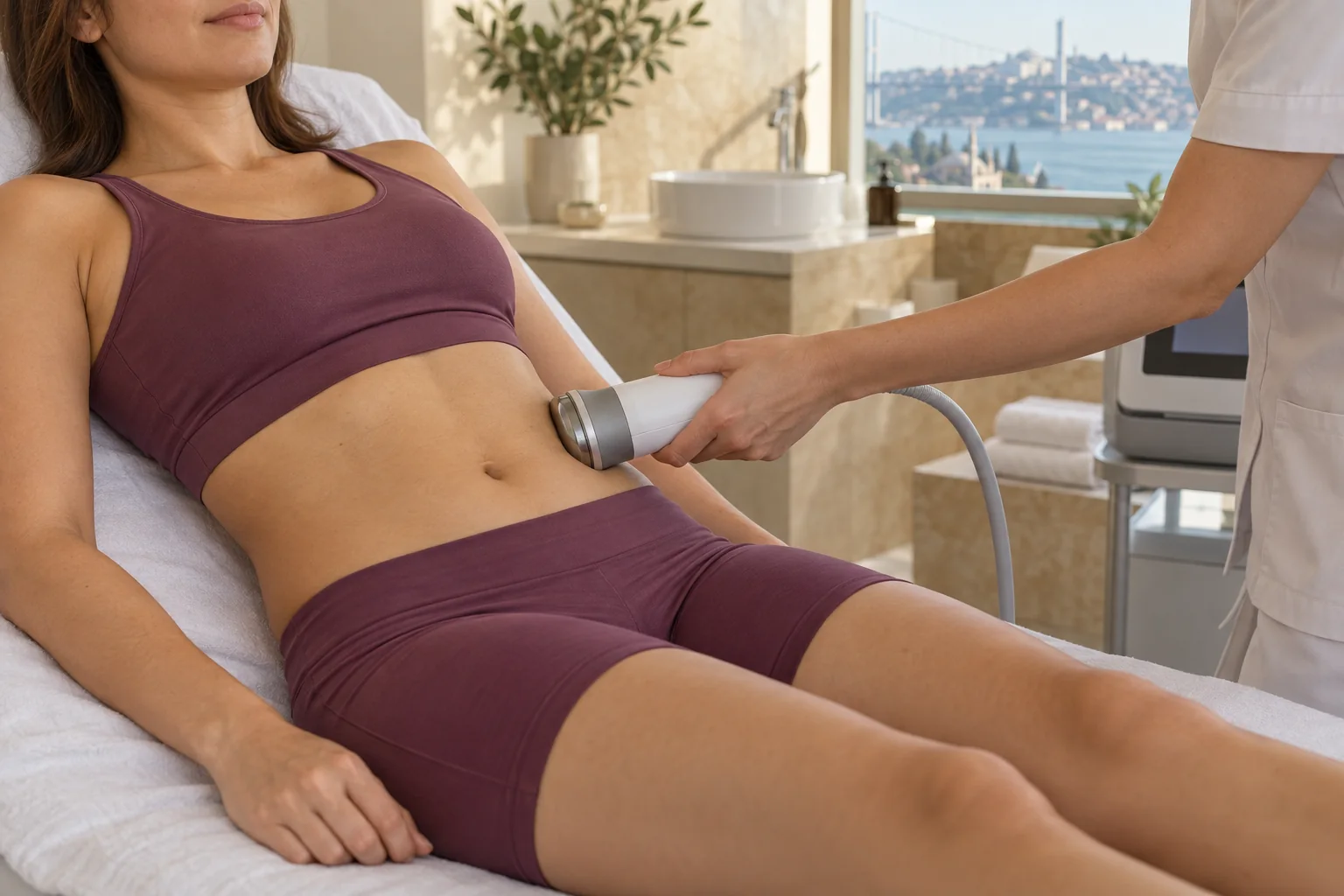
Search results for a non-surgical tummy tuck are mostly adverts. The useful question is not which machine has the friendliest name. It is whether your abdomen has a problem a machine can touch. Mild creasing is one problem. An apron of skin, or muscles that have separated, is another. This page keeps those apart and does not score brands.
What the term actually means
There is no entry in the surgical description of abdominoplasty for a tummy tuck done without an incision. The chapter defines the operation as removal of excess skin and subcutaneous fat, with tightening of the underlying muscle when indicated1. Removal means tissue leaves the body. A traditional operation also transposes the umbilicus1. None of that happens through a device applied to intact skin.
The non-surgical phrase borrows the operation people have heard of and attaches it to something else. That something else may be a course of appointments. It is not a mini, a full, or an apronectomy. Those remain operations, listed on the types page. If a clinic says the device is a tummy tuck, ask what tissue will be removed and whether any muscle will be sutured. If the answer is neither, it is not a tummy tuck.
Main technologies
Three families cover most of what is marketed at the abdomen. They are described here in general, not as a ranking. This site does not recommend or condemn a brand.
- Radiofrequency heats tissue under the skin. The claim is a modest tightening effect and, with some devices, an effect on small fat deposits.
- High-intensity focused ultrasound (HIFU) focuses ultrasound energy at a depth under the skin. The claim, again, is tightening rather than excision.
- Cryolipolysis cools a pinch of fat so that some of those fat cells are later cleared by the body. The claim is a reduction in a small bulge, not a removal of loose skin.
Other devices exist. The category does not change because the energy source does. Nothing in this list cuts out skin or places a stitch in the abdominal wall.
What they can do
The fair claim is a small one. Mild laxity, a slight crease, or a localised pad of fat in someone whose skin still has recoil, is the territory these devices advertise. Some people notice a change. Some do not. A change, when it happens, is not the change of an operation that has taken a wedge of skin away. Clothes may sit a little differently. An apron does not disappear.
Fat reduction by cooling is still fat reduction in a treated pinch, not weight loss and not skin excision. Skin tightening by heat or ultrasound is a surface and subsurface effect. It does not relocate the belly button or pull the upper abdomen down. If a provider shows you a result that looks like a surgical tummy tuck, ask whether that person had surgery.
What they cannot do
They cannot do the jobs that define abdominoplasty. They cannot remove excess skin and subcutaneous fat1. They cannot tighten the underlying muscle when that is indicated1. A hanging apron, including the apron people ask to have removed after weight loss, stays until it is cut away. Separated muscles stay separated until they are brought together surgically.
That is also why a device is not an apronectomy and not a fleur-de-lis tummy tuck. Those operations exist because the skin volume is beyond what recoil, exercise or a handpiece will deal with. What surgery can do that devices cannot is set out on what a tummy tuck is.
Evidence and realistic results
A realistic result from a device, if there is one, is modest and local. It is not a flat abdomen in someone who had a pannus. This page does not quote a percent improved, a percent satisfied, or a duration in years. Those numbers would have to come from a trial of a named device, and no such trial is in the source library used here. A brochure percentage is not a substitute.
Photographs in adverts are a weak kind of evidence. Lighting, posture and breathing change an abdomen. This site does not publish patient before-and-after photographs for that reason. Prefer a description of what tissue was treated over a gallery. If the only support offered is a testimonial, you do not yet have a result you can generalise.
Ask what will be different if you do nothing. Mild laxity often changes little over a short course of treatments, and it also often changes little if you decline them. A hanging apron will not tighten itself because a device was tried first. Spending months on sessions can be a reasonable experiment when you already understand the limit. It is a poor experiment when you were told the device is a tummy tuck and you discover afterwards that the skin you wanted removed is still there. Get the limit in writing before the first session: no skin excision, no muscle suture, no moved belly button.
Regulation of non-surgical treatments in the UK
Surgery and devices are not regulated as if they were the same act. Where a healthcare professional offers cosmetic surgery that inserts instruments into the body, the provider has to register with the Care Quality Commission2. The government page that states this uses tummy tuck as one of the examples. Registration is a legal requirement for that provider. It is not a league table, and it does not mean a result is endorsed.
The same government page is a consultation on licensing non-surgical cosmetic procedures in England2. Read that for what it is: a consultation about a licensing scheme, not a statement that every high-street device has been through the same registration as an operation. This page does not summarise which treatments the consultation puts in which group. Oversight of non-surgical work has not been the same thing as CQC registration of a surgical tummy tuck. That gap is why a surgical-sounding name on a device is a poor guide to how the provider is regulated.
Asking who will do the treatment, what training they have, and what happens if the skin is burned or uneven, is reasonable consumer caution. This site does not name a clinic to choose or to avoid.
When surgery is the only option
Surgery is the option that matches the problem when skin must be removed or muscle must be repaired. A tummy tuck does those things. A device does not. Which operation, if you get that far, depends on where the skin is: below the belly button only, above and below, out to the flanks, around the trunk, or a hanging apron without a cosmetic muscle repair. Those choices are the rest of the types section.
Surgery is not the only option when the skin is firm and the concern is a small fat pocket, or when you do not want an operation at all. Doing nothing is a valid choice. A device may be a reasonable experiment for mild laxity if you understand the limit. It is not a staging post that turns into a tummy tuck if you attend enough sessions. The fee for an actual operation, if you later want one, is explained only on the fee guide. Device session prices are not that fee, and they are not printed here.
FAQ
-
Is there a non-surgical tummy tuck?
There is no operation by that name that avoids surgery and still does what a tummy tuck does. The phrase is a marketing umbrella for devices aimed at mild looseness or a small pocket of fat. A tummy tuck removes excess skin and can tighten muscle. A device sitting on the skin does not cut skin away and does not suture muscle. If you need those steps, you need an operation. The phrase on an advert does not change that.
-
Do skin-tightening devices work?
They are offered for mild laxity, and some people see a small change. This page does not quote a success percentage, because no device trial is in the sources used here. They do not remove a hanging apron. They do not replace a tummy tuck when skin has lost recoil after pregnancy or weight loss. Judge a claim by whether it shows removed skin, which a device cannot produce, rather than by a before-and-after photograph of a slight crease.
-
Can they fix diastasis?
No. Diastasis is a separation of the abdominal muscles. Tightening those muscles, when it is indicated, is a surgical step inside an abdominoplasty. Heat, ultrasound or cold applied to the skin does not bring the muscles back to the midline. Exercise may help how the wall feels. It does not stitch a wide gap. If the bulge is muscle, a device labelled as a tummy tuck is the wrong tool.
-
What can non-surgical treatments not do?
They cannot cut away an apron of skin. They cannot move the umbilicus. They cannot repair the abdominal wall the way an operation can. They cannot turn a large weight-loss apron into a flat abdomen. Mild creasing and a small fat bulge are the claims in their own marketing. Anything beyond that is a surgical problem, described on the page about what a tummy tuck actually does.
-
How are non-surgical cosmetic treatments regulated in England?
A tummy tuck that inserts instruments into the body is a regulated activity. The provider has to be registered with the Care Quality Commission. Non-surgical cosmetic procedures are the subject of a government licensing consultation, which is a different regime from that surgical registration. This page does not list which devices are inside that scheme. Registration of a clinic is not a ranking, and it is not an endorsement of a result.
-
When is surgery the option that matches the problem?
When the problem is excess skin, a hanging apron, or muscles that need to be repaired. Those are the jobs an abdominoplasty is described as doing. Devices do not do them. Surgery is the wrong match when the skin is tight and the only issue is a small fat pocket that liposuction, or nothing at all, might address. The type of operation, if surgery is the match, depends on where the skin sits.