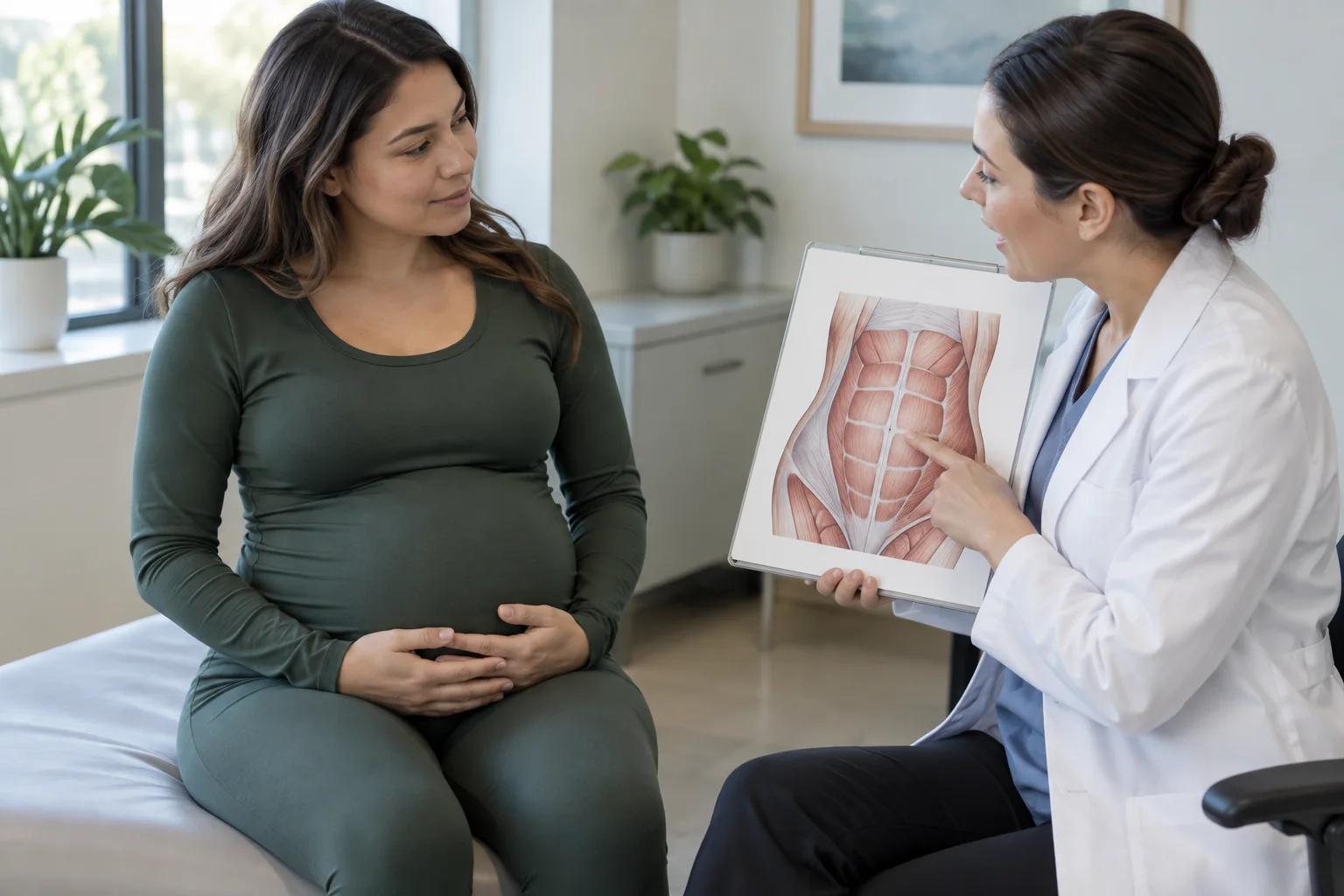
People ask about pregnancy after a tummy tuck in two moods. One is planning: should I wait? The other is news: I am pregnant, and I am worried I have done something wrong. The first mood deserves a clear trade-off. The second deserves a straight face and no lecture. A pregnancy is not an insult to an operation. An operation is not a contract to never have a child.
Is it medically safe?
The honest limit comes first. The sources confirmed for this site describe the operation. They do not follow patients into a later pregnancy. There is therefore no percentage on this page for miscarriage, wound problems in pregnancy, or problems in labour. If you see a precise figure elsewhere, ask which paper it came from. It did not come from the library this site is using.
What can be said is mechanical, and it is cited as a description of the operation rather than as obstetric research. A tummy tuck is designed to remove excess skin and subcutaneous fat and, when indicated, tighten the underlying muscle1. Pregnancy after that asks the abdominal wall to expand for months. Whether you and this pregnancy are medically fine is an antenatal question. Book with maternity care. Do not use a cosmetic guide as a clearance.
How pregnancy can affect results
Skin that was pulled tight can stretch. A repair of the abdominal muscles can be put under the same pressure that stretched those muscles in a previous pregnancy. Stretch marks can appear on skin that looked clear after surgery. The navel can change shape again. None of this is certain in degree. Some abdomens tolerate a pregnancy with a modest change. Some loosen a great deal. The confirmed sources do not sort people into those groups with a percentage, and this page will not dress a guess as a finding.
Muscle tightening is part of many tummy tucks, not all of them. If you know whether yours included a repair, that detail is worth telling the maternity team. What the repair is, in plain terms, is covered on the muscle repair page. A repair is stitches in the muscle layer. It is not armour, and it is not a reason to feel you have broken something by becoming pregnant.
| Question | Can be said | Cannot be said from these sources |
|---|---|---|
| Is a later pregnancy medically safe? | Maternity care has to assess you. This page has no rate. | A percentage, or a promise either way. |
| Will the contour change? | It may. Skin and muscle are asked to stretch again. | That every result is ruined, or that none is. |
| Should you feel at fault? | No. | Any version of blame. |
Why surgeons advise waiting until you have finished having children
The advice is common because the operation and a future pregnancy pull in opposite directions. Surgery removes lax skin and can tighten muscle that pregnancy is one reason people develop in the first place. A standard account lists skin laxity, excess fat, and muscle laxity, including after pregnancy1, among the reasons people have a tummy tuck. BAAPS patient information says that if you are pregnant or planning to become pregnant, your surgeon may suggest delaying the operation2. Doing that operation, and then asking the same wall to carry another pregnancy, can mean a second recovery if you want the contour back.
Waiting until you have finished having children is a way to spend the recovery once. It assumes you know you have finished, which not everyone does. Plans change. A new partner, a change of mind, or a surprise are ordinary human events. The advice is still worth hearing before you book, while the order is a choice. It is not a clause that makes a later pregnancy a breach. If a consultation talks as if you would be letting the surgeon down, that is a tone problem, not a medical finding.
The same planning point sits on the candidacy page, beside weight and smoking. The safety section is where this page belongs. It is not a fertility consultation.
If you become pregnant afterwards
Tell the people looking after the pregnancy. Say that you have had an abdominoplasty, and say whether the muscles were plicated if you know. Take any operation note you were given. Then let antenatal care do its job. This website will not tell you how to give birth, whether a caesarean is wiser, or what the scar means for the uterus. Those sentences would be invented, and invented obstetric advice is worse than a gap.
You do not owe anyone an apology. You can be glad about the pregnancy and annoyed that the abdomen may change. Both feelings can be true. If, after you have recovered from the birth and your weight has settled, you want to know what another operation could and could not do, that is a fresh decision. Read what a tummy tuck changes before you treat a second operation as a reset button. Some people never want another one. That is a complete answer.
During the pregnancy, urgent symptoms are still urgent. Contact your maternity unit as you have been told to, and contact your GP or NHS 111, or call 999 in an emergency. A previous tummy tuck is not a reason to wait at home with chest pain, heavy bleeding, or a severe headache because you are embarrassed about the scar.
Frequently Asked Questions
-
Is it safe to get pregnant after a tummy tuck?
This site cannot call pregnancy after a tummy tuck safe or unsafe with a number. The sources confirmed here do not report a complication rate for a later pregnancy. They do describe what the operation changes: excess skin and fat are removed, and muscle may be tightened. A later pregnancy stretches the abdominal wall again. Whether that pregnancy is medically straightforward is a question for your maternity team, who can see you. It is not a question a cosmetic-surgery article should answer with a slogan.
-
Will pregnancy ruin a tummy tuck?
It can change the result. Skin that was tightened can stretch, and a muscle repair can loosen as the uterus grows. Some people still like their contour afterwards. Some feel they are back where they started, or somewhere in between. “Ruin” is a blame word, and it is the wrong word. A pregnancy is not a mistake you made against the operation. It is a later event that the tissues may not ignore. If the result changes, a revision is an option to discuss afterwards, not a punishment.
-
Why do surgeons say to wait until you have finished having children?
Because the operation is built to remove loose skin and, when indicated, to tighten muscle, and a future pregnancy asks those same tissues to stretch. BAAPS patient information says that if you are pregnant or planning to become pregnant, your surgeon may suggest delaying the operation. Waiting until you have finished having children is planning, so you are not put through a recovery you may want to repeat. It is advice, not a rule you can break in a moral sense. People change their minds about children. The fair use of the advice is to hear it before you book, while you can still choose the order of events.
-
I am already pregnant. What should I do?
Tell your midwife and obstetric team that you have had a tummy tuck, including whether the muscles were repaired. They plan the pregnancy. This page does not. Ordinary pregnancy symptoms still belong with maternity care, and urgent symptoms still belong with your GP, NHS 111, or 999. You do not need to apologise for the pregnancy. You do need the people looking after the pregnancy to know about the scar and any muscle repair, so they are not guessing.
-
Can I have another tummy tuck after the pregnancy?
Sometimes, if there is loose skin or muscle laxity again and you want another operation after you have recovered from the birth. It is a new decision, with a new recovery and the same kind of scar. It is not owed to you, and it is not required of you. Many people never have a second operation. If you do ask about one, the useful time is after your weight and the abdominal wall have settled, not in the first weeks after delivery. The page on what a tummy tuck changes is the boundary to read before that conversation.
-
Does a tummy tuck affect labour?
The sources used on this page do not say how a previous abdominoplasty changes labour, induction, or the chance of a caesarean. Inventing that advice would be worse than a gap. Tell the maternity team about the operation and let them assess you. A scar on the skin is not, by itself, a story this website can turn into a birth plan. If something in the pregnancy worries you, the route is maternity care, not a search for other people’s operations.