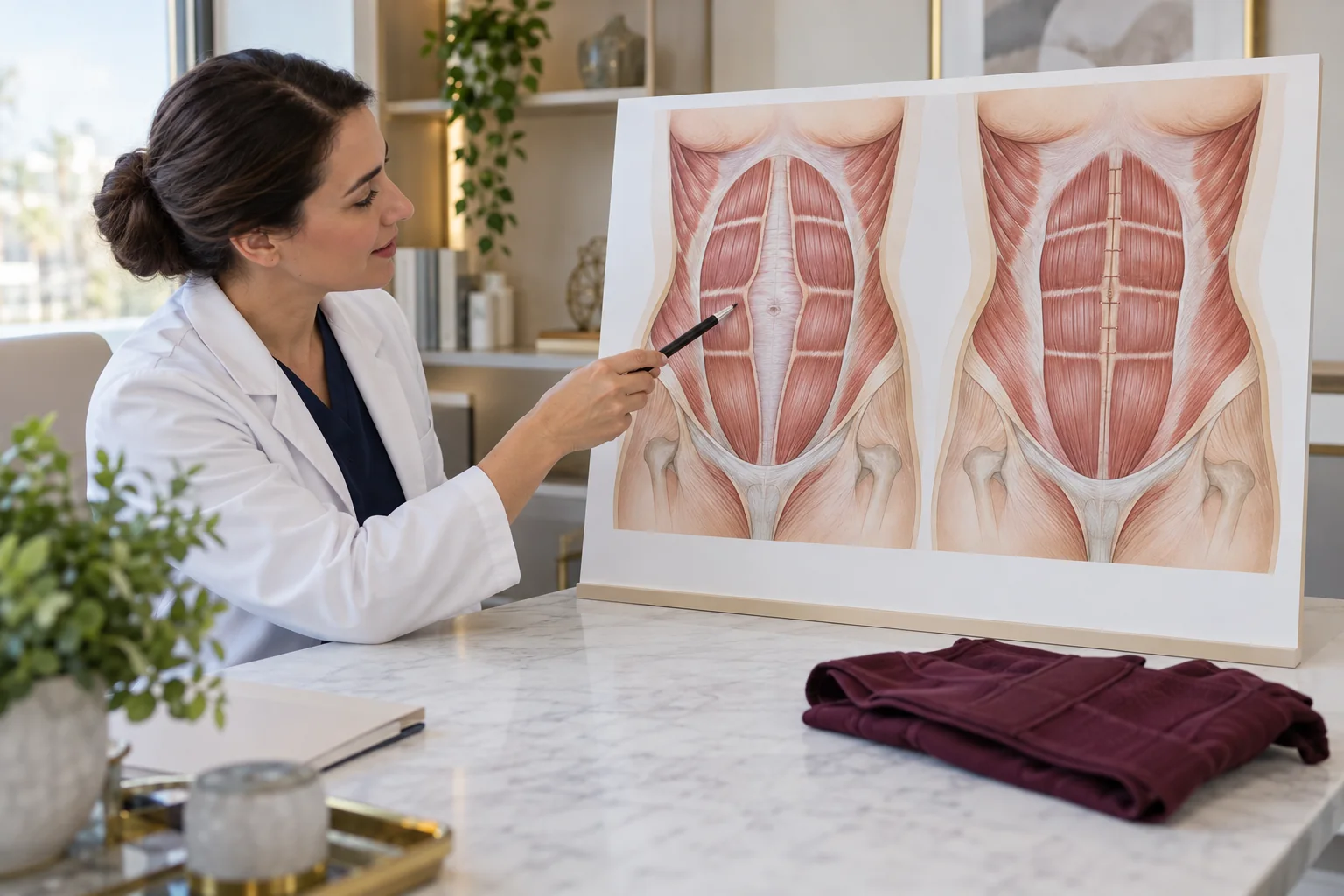
What rectus plication is
The two rectus abdominis muscles run vertically on the front of the abdomen, one on each side of the midline. Between them is a band of connective tissue. In some people that band stretches, and the muscles sit further apart than they did. You may see a doming or a gap when you lift your head while lying down. That finding is a reason to be examined. It is not, on its own, a decision to operate.
Rectus plication is the surgical step that folds the tissue in the midline and sutures it so the gap is narrowed. On this site, muscle repair means that tightening. The surgeon does not remove the muscles. The suture line is in the abdominal wall, under the skin. It is not a second skin scar. The skin scar of a tummy tuck is a different line, usually low on the abdomen, and it is described on the page about what the operation involves.
A tummy tuck is built around skin. Loose skin, and the fat on the piece that is taken away, is removed, and the remaining skin is drawn down. Plication is an extra step, used when the surgeon judges the abdominal wall itself is part of the problem. It is not automatic. A quote that says only "tummy tuck" has not promised a repair, so ask which steps are in the plan and ask for that answer in writing.
With vs without muscle repair
Some operations remove skin and leave the muscle layer as it is. Some do both. The difference matters for what you are agreeing to, and for how the abdomen feels in the first weeks.
Without repair, the operation is the skin work: taking away the excess and re-draping what remains. If there is a gap between the muscles, it is still there when you wake up. That can be the right plan when the muscle layer is not the issue the surgeon has identified, or when a repair would add a risk that is not justified for you. Skin removal alone can still change the outline of the abdomen. It does not tighten the midline.
With repair, the surgeon adds plication. The aim is a more supported abdominal wall in the midline, alongside the skin result. It does not take fat off the whole trunk, and it does not stand in for a change in weight. It also does not promise a particular shape. Swelling hides the contour for weeks, so the look in the first fortnight is a poor guide to the result. This page does not show patient photographs.
| Question | Without muscle repair | With muscle repair |
|---|---|---|
| Skin | Excess skin can still be removed | Excess skin can still be removed |
| Midline muscles | Left as they are | Tightened when the surgeon judges it is indicated |
| What to confirm in writing | That repair is not part of this plan | That plication is part of this plan |
Ask for a sentence that a stranger could understand: whether the rectus muscles will be plicated, and whether that step is included in the fee you are discussing. How this site handles the fee is on the fee guide. No figure is printed here.
Diastasis recti: when it matters
A widened gap between the rectus muscles is the situation in which plication is usually discussed. Clinicians call that gap a diastasis. How wide it is, whether a true hernia is also present, and whether an operation is the right response are not questions this hub can answer from a description you type into a search box.
The decision sits on the page about diastasis recti surgery: what the finding is, in short, how severity is assessed, when an operation is considered and when it is not, and how repair inside a tummy tuck differs from a repair on its own. Read that page if the gap itself is why you are looking at surgery. Stay on this page if you are still separating "muscle repair" from skin removal.
A gap that shows when you sit up is a reason to be examined. It is not a measurement this site will turn into a rule. This hub does not print a centimetre cut-off, because a cut-off without an examination is not a clinical decision.
In men
Men can have the same separation. Heavy lifting, a change in weight, and a family tendency are reasons people ask about it. None of those is a diagnosis, and none of them is a reason to operate without an examination. A photograph of the abdomen, taken from above, is not an assessment.
The page on diastasis recti in men covers how the gap is assessed, when surgical repair is considered, and how that repair can be done with a tummy tuck or without one. It points to the NHS page for funding questions. If you are a man and you came here because of the gap rather than because of loose skin, start there.
Recovery implications
Plication changes the early weeks, because the abdominal wall has been tightened as well as the skin. People are often more comfortable slightly bent at the hips for a time, and a sudden straightening can pull on the repair. How long that lasts is individual.
Drains and limits on lifting are often part of a tummy tuck plan. They are your surgeon's instructions, not a protocol published here. Urgent problems are the same as on the recovery pages: contact GP or NHS 111 for a worrying wound, temperature or new one-sided swelling; call 999 if acutely unwell. If the surgeon will be in another country when you are at home, who handles follow-up is a question for the abroad section.