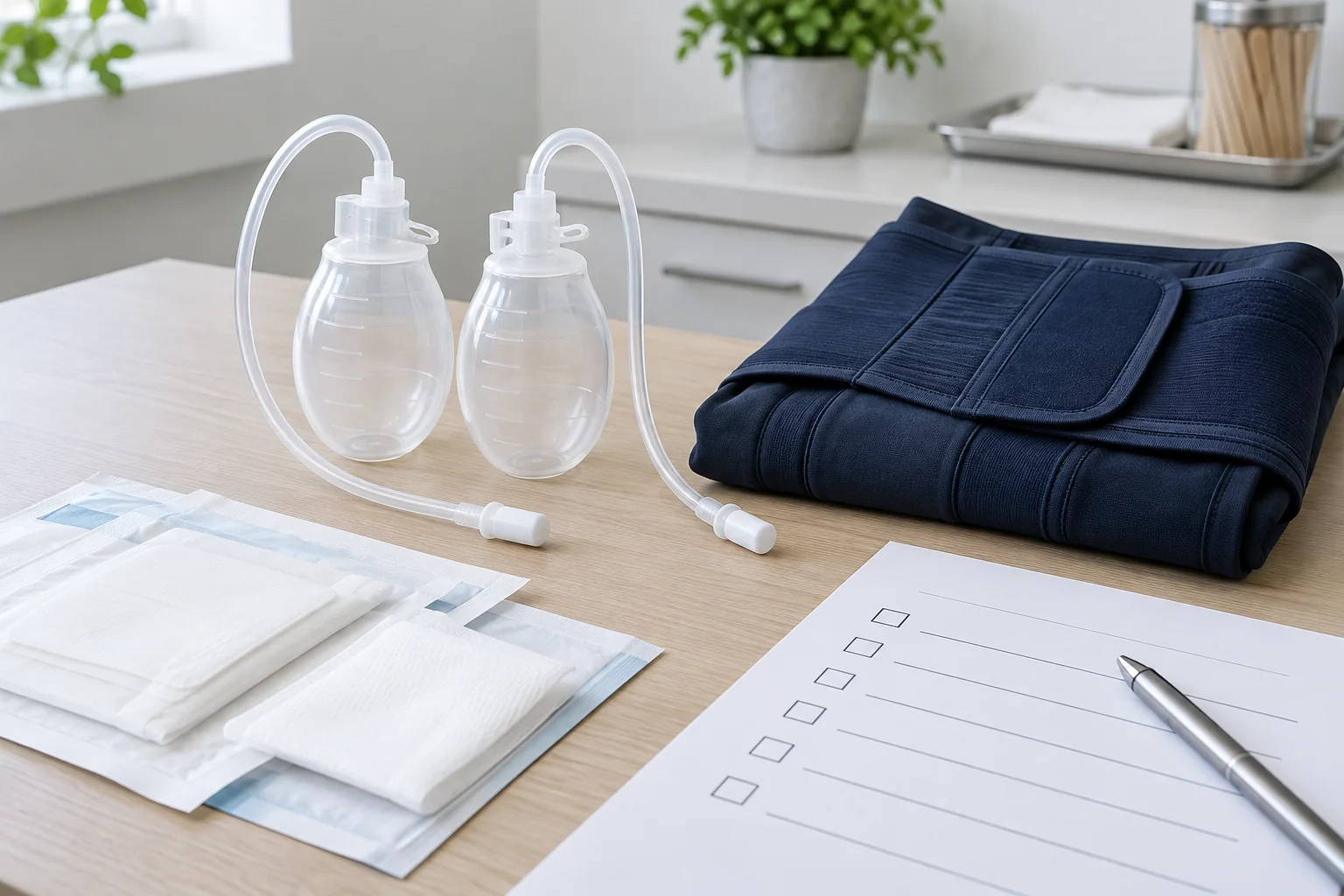
A drain is a practical object: a thin tube from under the skin to a small bulb or bag. A seroma is what people worry the drain was meant to stop. Both need plain descriptions, because the words get used as if they were opinions about whether the operation was done properly. They are not. They are about fluid in a space the surgery created.
Why drains are used
When the abdominal skin is lifted off the muscle fascia, a raw space is left until the flap sticks back down. Fluid weeps into that space. A drain gives the early fluid a way out, so it does not sit there as a collection. A standard account of abdominoplasty says one or two drains are typical: often one along the incision and one over the umbilicus1. The same account says drains are routine but not mandatory1.
If you go home with a drain, you should know three things before you leave: how to empty and record it, what colour of fluid you were told to expect, and the number to call if it falls out or the output changes suddenly. The tube is secured for a reason. Pushing a fallen drain back in is not first aid. Neither is trimming it so it hides under clothes.
Drainless techniques
Some closures use progressive tension sutures. These are stitches that quilt the underside of the skin flap down to the muscle covering, closing the space in strips so there is less room for fluid. Some surgeons combine those sutures with a drain. Some also preserve a layer of fat under Scarpa’s fascia rather than lifting every bit of it. “Drainless” is a technique. It is not a guarantee, and it is not a moral improvement on having a drain.
The balanced reading of the evidence is in a meta-analysis of 4,295 patients. Overall complication rates in the included studies ranged from 9.3% to 33.8%2. For seroma, haematoma, infection, skin or fat necrosis, wound opening, revision, and venous thromboembolism, the authors found no significant difference between the combinations of drains, progressive tension sutures, and sub-Scarpal fat preservation2. Use that sentence against anyone who says a drainless tummy tuck has been shown to prevent seroma. Also use it against anyone who says a drain has been shown to prevent seroma. The paper does not award that win.
| Question | What can be said | What cannot |
|---|---|---|
| Are drains used? | Commonly one or two. Not mandatory. | That every safe operation has a drain. |
| Do they stop seroma? | This meta-analysis did not show a significant difference. | That drains prevent seroma, or that they are pointless. |
| Is seroma rare? | It is one of the local complications reviews discuss. | A seroma-only percentage. None is cited here. |
What a seroma is and how it feels
A seroma is serum, the watery part of blood, collected in a pocket. People often describe a waterbed feeling: a soft swelling that ripples when you press it, or a wave when you change position. It may be more obvious on one side of the lower abdomen. General tummy tuck swelling is more even, and it tends to track the time of day. The two can exist together, which is why pressing your own abdomen is a poor test. The difference is explained from the swelling side on the swelling page.
Seroma sits on the list of local complications discussed in a review of abdominoplasty3. That review’s headline figures are about 10% to 20% for local complications and under 1% for systemic ones3. Those are not a seroma rate. Quoting them as “your chance of a seroma” would be a misuse of the number.
How it is treated
A clinician treats a seroma that needs treating by aspirating it: a sterile needle, a syringe, and a decision about whether to repeat that if the fluid returns. Small collections are sometimes watched. A collection that keeps returning may need a new drain or, less often, an operation to close the space. Antibiotics are for infection, not for every pocket of clear fluid. This page will not name an antibiotic or a dose, and it will not tell you how far to insert a needle. That is the opposite of safe advice.
If you are offered aspiration, ask how many visits are likely, what to do if the swelling returns at the weekend, and which symptoms would make it urgent rather than routine. Recurrence is the annoying part of seromas. It is still a job for the clinic or for urgent care, not for a relative with a sewing kit.
When to get help
Most drain questions are dull and can wait for the number you were given: the bulb will not hold suction, the stitch is itchy, the output is slowly less each day. These should not wait:
- the drain falls out or is pulled part-way
- the fluid becomes suddenly bright red or the bulb fills much faster than before
- the abdomen swells quickly after the drain is removed
- you develop a high temperature, or redness spreads from the drain site
- you are breathless or have chest pain
Contact your GP or NHS 111, or call 999 in an emergency. If the problem is pain, fever, or a wound that is not a simple fluid pocket, the wider account of signs something is wrong is the page to read after you have asked for help, not instead of it. The recovery overview links the rest of the early weeks.
Frequently Asked Questions
-
What is a seroma after a tummy tuck?
A seroma after a tummy tuck is a collection of fluid under the skin, in the space left when the abdominal flap was lifted. It can feel soft, watery, or sloshy, and it may sit in one patch rather than as even swelling across the whole abdomen. It is one of the local complications described after this operation. It is not, by itself, the same thing as the general puffiness most people have in the first weeks. A clinician confirms it by examining you, and sometimes with a needle or a scan. You should not test it with a needle at home.
-
Why do some people have tummy tuck drains and some do not?
Drains are commonly used, often one or two of them, and they are not mandatory. Some surgeons close the space with progressive tension sutures and do not leave a drain. A meta-analysis of 4,295 patients did not find a significant difference in individual complications, including seroma, across the combinations of drains, those sutures, and preserving fat under Scarpa’s fascia. That is a reason to be sceptical of a slogan that one method prevents seroma. It is not a reason to remove your own drain.
-
What should drain fluid look like?
At first it is often red or dark pink, then it becomes more watery and lighter. The amount usually falls over the days the drain stays in. A sudden return of bright bleeding, a drain that fills very quickly, or a drain that falls out needs a call the same day. This page does not give a millilitre limit, because the threshold is the one your team set for you. Write down the output if you were asked to. Do not cut the drain shorter or push it back in.
-
How is a seroma treated?
The usual treatment is aspiration: a clinician draws the fluid out with a needle and syringe, sometimes more than once, because a seroma can refill. Some collections are watched if they are small. Some need the drain replaced or, less often, a return to theatre. Those choices are made by the person examining you. This page does not describe how to aspirate a seroma and does not give a drug or a dose. If you are also feverish or the skin is rapidly red, say so. Infection and a simple seroma are not treated as the same event.
-
Can I prevent a seroma by wearing compression?
Compression is part of many aftercare plans. It is not, on the evidence used here, a proven way to stop a seroma from forming. The comparative research did not crown one technical combination as clearly better for seroma. Wear what you were given, and keep your follow-up. Buying extra pressure because you are worried is not a prevention method this page can endorse. Report a new sloshy swelling rather than tightening a garment over it and hoping.
-
When should I get help about a drain or a seroma?
The same day, if a drain falls out, the fluid turns suddenly bloody, the abdomen swells quickly, you have a high temperature, or the skin is spreading red. Contact your GP or NHS 111, or call 999 if you are severely breathless, have chest pain, or are bleeding heavily. A falling daily output, in a drain you were told to expect, can wait for the planned removal. A new, soft, wavy swelling after the drain is out should be reported. Do not aspirate it yourself.