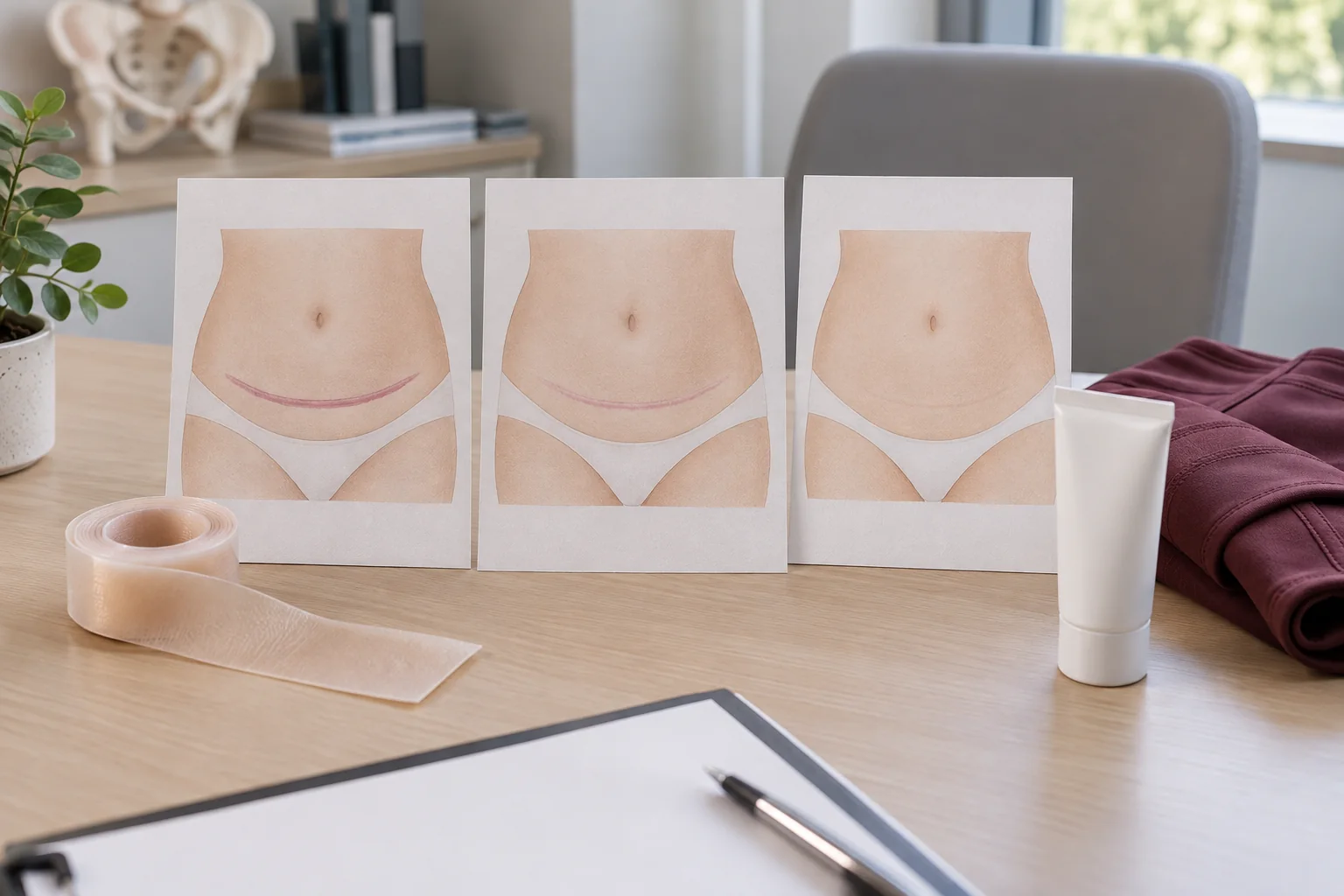
The scar is the part of a tummy tuck that surgery cannot tidy away. Skin has to be closed somewhere. People looking up tummy tuck scars are usually asking two things: where the line will sit, and whether it will still be obvious next year. The first can be described. The second can only be described as a range. Scars mature. They do not evaporate.
The stages below are the usual course people are told to expect. Your scar may be thicker, thinner, darker, or slower. Genetics, tension on the closure, infection, and sun all play a part. None of them is a reason for this page to sell a cream.
Where the scar sits
A traditional abdominoplasty uses a horizontal incision and moves the umbilicus1. The horizontal line is planned low, often in the area a pair of briefs or a swimsuit can cover, which is why it is sometimes called a bikini-line scar. “Can cover” is not “will be invisible when you are undressed”. When you bend, or when the scar is still red, it shows.
Because the navel is brought out through the skin that has been pulled down, there is a scar around the belly button as well. That circle, or oval, is easy to forget when people only talk about the long line. How it heals is the subject of the belly button page.
A mini abdominoplasty is different. It uses a shorter, lower incision and does not reposition the umbilicus1. There is less scar, and there is usually no new scar around the navel, because the navel was not moved. That shorter scar is also why a mini operation does not deal with loose skin above the belly button. The scar you accept and the skin you can remove are the same decision.
| Time | Often described | What not to conclude |
|---|---|---|
| First weeks | A closed line, sometimes with crusting or tape marks | That the final colour is already visible |
| About 1 to 3 months | Pink or red, and sometimes firm or itchy | That a pink scar has “gone wrong” |
| About 6 months | Often flatter, colour still changing | That maturation has finished |
| About 12 to 18 months | Usually softer and paler than the early scar | That every scar becomes hard to see |
How scars mature
A new scar is a repair, not a patch of ordinary skin. In the first weeks the line is fragile. Over the next months many scars become redder or more raised before they settle. Itching is common. The usual window people are given for maturation is about 12 to 18 months. During that time the scar often softens, flattens, and fades from red toward a paler line. Some stay pigmented, wide, or rope-like. A photograph at six weeks, or even at six months, is an interim picture.
The week-by-week timeline puts this in the longer recovery, from the second month through the first year. Judging a scar in week three is like judging it before it has done most of its changing. That is also why revision of a scar, if it is offered at all, is usually discussed after the tissues have calmed down, not in the first fortnight.
Scar care with evidence
This is the section where product claims usually arrive, and where this page will be narrower than a shop. A literature review of abdominoplasty complications includes hypertrophic scars among the local problems it discusses2. The review’s summary does not rank gels, tapes, or oils, and the sources confirmed for this site do not include a trial of a named scar product. So this page will not quote a percentage improvement, and it will not name a brand.
What can be said without pretending there is a miracle:
- Follow the washing and dressing instructions you were given until the wound is closed. A closed scar and an open wound are not cared for in the same way.
- Silicone sheets and gels are widely used for raised scars. Use them only if the team has said the wound is ready, and do not expect them to remove the line.
- A new scar darkens more readily in the sun. Covering it, or using a sunscreen once the skin is intact, is common advice. This page does not give a sun-protection factor as a prescription.
- Massage is sometimes suggested once the wound is healed. It is not a reason to rub an opening.
If a product promises that a tummy tuck scar will disappear, that claim is bigger than the evidence this site can cite. The same review puts local complications at about 10% to 20% of patients, and systemic complications under 1%2. That range is not a scar-treatment success rate. It is a reminder that wound problems are the commoner kind of complication, not that a cream prevents them.
Hypertrophic and keloid scars
A hypertrophic scar stays bulky. It is raised, and sometimes red or itchy, but it keeps to the area of the incision. A keloid grows past the original wound into skin that was not cut. Keloid scarring is more likely in some families and on some areas of the body. The abdomen is not the classic site people mention first, and this page will not invent a rate for keloid after a tummy tuck. The review names hypertrophic scars. It does not, in the summary used here, give a separate keloid percentage.
Treatment of a thick scar, if it is offered, may include silicone, steroid injection, or later revision. Those are clinical decisions. This page does not describe how to inject a scar and does not give a dose. A scar that is slowly thickening can be discussed at follow-up. A scar that splits open, discharges pus, or sits in spreading redness is an acute wound problem, not a cosmetic preference.
Fleur-de-lis vertical scar
When skin is loose from side to side as well as from top to bottom, a surgeon may add a vertical cut to the low horizontal one. The pattern is called fleur-de-lis. The vertical limb runs up the midline. It removes more skin. It also leaves a scar that underwear may not hide, especially above the navel. That is the trade: more tissue gone, more scar to live with.
The operation itself, and who it is sometimes considered for after a large weight loss, is on the fleur-de-lis tummy tuck page. This page only owns the scar. A vertical scar matures on the same slow clock as the horizontal one. It is not a lesser scar because it is a different shape. If you are comparing operations, put the extra line in the decision before the day of surgery, not after.
When to seek advice
When to get help depends on what the scar is doing. A line that is pink, itchy, or slightly firm in the first months is usually a maturing scar. Ask about it at the planned review if you are unsure. Do not wait for a routine appointment if:
- the wound opens or the edges pull apart
- dressings are soaked with blood
- redness is spreading, the skin is hot, or you have a high temperature
- there is a foul smell or pus
- you feel suddenly breathless or have chest pain, which is not a scar question but still an emergency
Contact your GP or NHS 111, or call 999 in an emergency. NHS 111 is the right call when you need urgent advice and you are not in immediate danger. Call 999 if you think the problem is life-threatening. This site cannot assess a wound from a message. The rest of the early weeks, including drains and walking, is on the recovery pages.
Frequently Asked Questions
-
Does a tummy tuck scar disappear?
No. A tummy tuck scar is permanent. What changes is the scar’s colour, firmness, and how noticeable it is. Early on it is often pink, red, or slightly raised. Over about 12 to 18 months it usually flattens and fades, and it may stay visible in good light or when you lean forward. Anyone who promises that the scar will vanish is describing a result this page cannot support. The scar is the trade for the skin that was removed.
-
Where is a tummy tuck scar placed?
On a traditional operation the main scar is a horizontal line, low on the abdomen, often planned so that underwear can cover it. If the navel is moved, there is a second scar around the belly button. A mini operation uses a shorter, lower scar and, in the description used here, does not move the navel. A fleur-de-lis operation adds a vertical scar. The exact line depends on your skin and on the operation you had, not on a diagram alone.
-
What scar care actually has evidence behind it?
Hypertrophic scars are one of the local problems a major review of abdominoplasty discusses. That is not the same as a product trial. Silicone sheets and gels are widely used, and people are often told to keep a new scar out of strong sun. This page does not cite a success rate for any brand, because the sources confirmed for this site do not report one. There is no oil, cream, or tape here that is described as able to erase a scar.
-
What is the difference between a hypertrophic scar and a keloid?
A hypertrophic scar is thick or raised but stays roughly within the line of the wound. A keloid extends beyond that line into nearby skin. The review cited on this page names hypertrophic scars among abdominoplasty complications. It does not give a separate rate for keloid, so this page does not invent one. A scar that keeps growing, itches intensely, or spreads past the incision should be seen. Treatment, if any, is a clinical decision, not a home recipe.
-
Why does a fleur-de-lis tummy tuck leave a vertical scar?
A fleur-de-lis pattern adds an up-and-down scar to the low horizontal one, so more loose skin can be removed from side to side as well as from above. The extra scar is the trade-off. It is more scar, not a hidden one, and it can be harder to cover. Whether that trade is worth it depends on how the skin sits, especially after a large weight loss. The type of operation is explained on the fleur-de-lis page. This scars page does not decide who needs it.
-
When should I ask for advice about a scar?
Ask at planned follow-up if the scar is thicker, darker, or more uneven than you were led to expect. Contact your GP or NHS 111 the same day if the scar opens, bleeds enough to soak a dressing, becomes rapidly more red and painful, or you develop a high temperature. Call 999 if you are severely unwell or bleeding heavily. A pink, itchy scar in the first months is common. A wound that comes apart is not something to photograph and wait on.