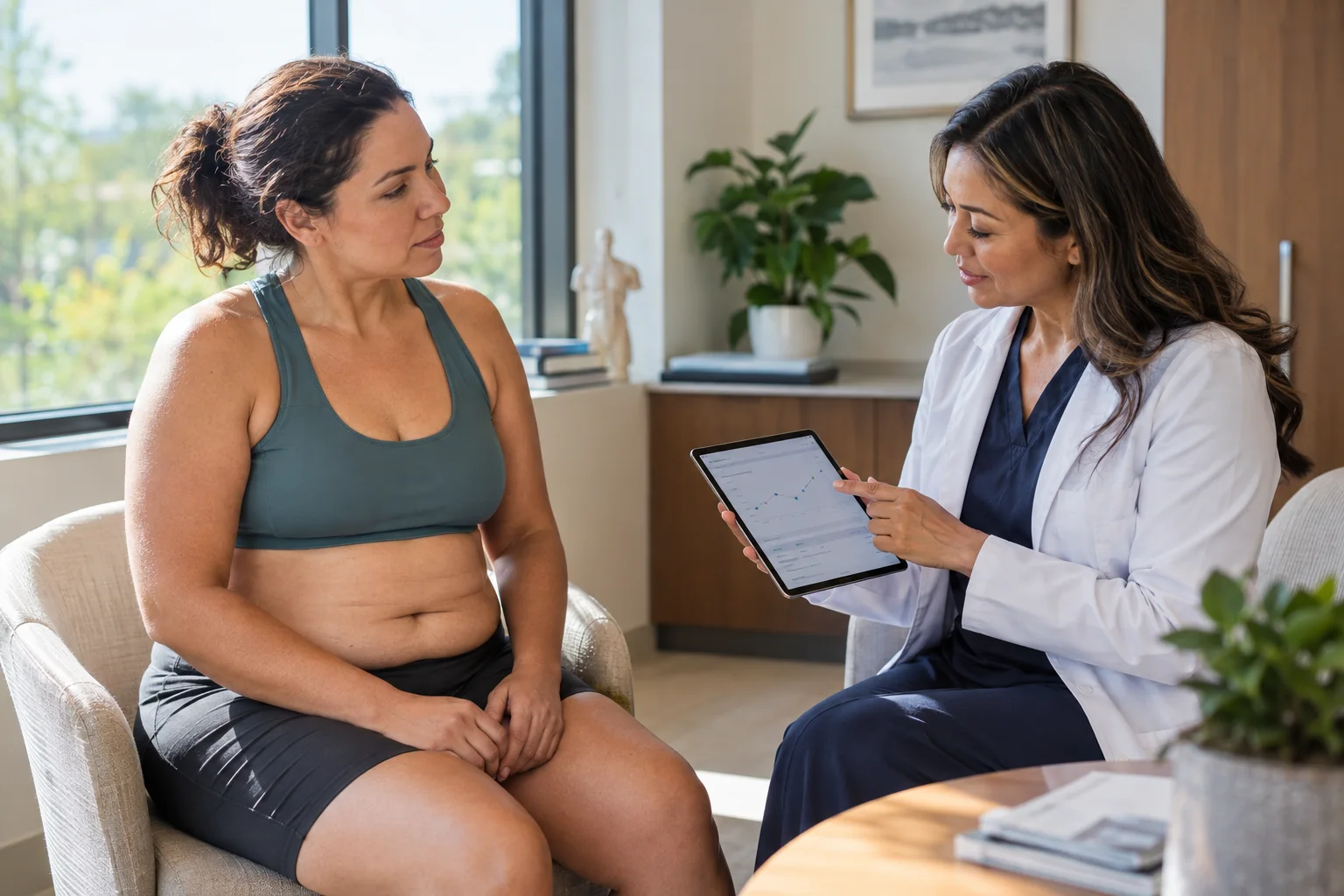
Candidacy is the question underneath the brochure. Not “what is a tummy tuck”, but “is it for me, now?”. A website can say what the operation is designed to change, and what commonly makes a team hesitate. It cannot examine your abdomen, your heart, or your reasons. Treat the sections below as the conversation to have, not as a score that adds up to yes.
What makes a good candidate
A standard description of abdominoplasty says it is meant to improve abdominal contour by removing excess skin and subcutaneous fat and, when indicated, tightening muscle1. The same chapter lists skin laxity, excess fat, and muscle laxity1, including after pregnancy or major weight loss, and functional problems from redundant skin, such as irritation or trouble with hygiene1. A good candidate, in that sense, has a problem the operation can actually touch.
The person also has to want the trade. The trade is a scar, a recovery measured in weeks of limited activity and months of swelling, and a result that is a contour change rather than a new body. If the hope is a clothes size, read what a tummy tuck changes before you go further. If the hope is weight loss, this is the wrong operation to pin that hope on.
Wound problems are common enough to belong in the decision. A 2017 review reported local complications in about 10% to 20% of patients and systemic complications in fewer than 1%2. The detail, and the refusal to invent extra rates, is on the risks page. Being a candidate includes being able to hear that range without needing it softened into nothing.
Best age — and why age matters less than health
People ask for the best age for a tummy tuck because they want permission. The sources used on this page do not name an ideal decade. Skin laxity can follow pregnancy in someone’s thirties. It can also be what someone wants addressed in their sixties, if they are well enough for the operation. The limiting factors are the ones an anaesthetic assessment actually uses: heart and lung health, medicines, whether wounds heal, and whether you can manage the early weeks at home. A birthday is a weak proxy for those.
If you are older, ask about recovery and support at home, not about whether you have missed a window this website invented. If you are younger, ask whether your weight and your plans for children are settled. Youth is not a substitute for either.
Stable weight
The skin removed at surgery is a snapshot. If your weight is still dropping fast, more laxity can appear afterwards, and the contour you paid for in effort and recovery can change. If your weight is climbing, the result changes in the other direction. Teams therefore talk about a period of stability before they operate. How long, and at what weight, is not a figure this page will fabricate.
The practical version of that conversation is on weight stability before a tummy tuck. Read it if the operation is in mind because you have already lost a lot of weight. Losing more, or regaining, is not a character issue. It is a reason the timing might be wrong.
Future pregnancy plans
A pregnancy after a tummy tuck can stretch skin and a muscle repair. Many surgeons suggest waiting until you have finished having children so that you are not lining up a second recovery. That suggestion is worth taking seriously while you are still choosing. It is not a reproach if you are pregnant already, or if you later decide you want a child. The pregnancy after page is written to keep those apart.
Say in the consultation whether another pregnancy is possible, hoped for, or finished. A surgeon who is not told cannot plan with you. A surgeon who shames you for the answer is giving you information about the consultation, which is also useful.
Smoking
Smoking is raised because wound healing, including the skin necrosis discussed in complication reviews, is the risk teams are trying to reduce. A 2018 meta-analysis of elective plastic surgery found that tobacco use raised the odds of total complications after abdominoplasty, with an odds ratio of 5.43 (95% confidence interval 2.92 to 10.10)3. The same paper links smoking with surgical-site infection, delayed healing, and skin necrosis across common aesthetic operations. That odds ratio is not a personal percentage, and the 10% to 20% local figure on this page is still an overall range, not a smokers’ rate and not a non-smokers’ rate.
What you can do is be accurate about nicotine, including vaping if that is what you use, and ask what that clinic requires before a date is offered. A GP can help with stopping. This article will not pretend that a paragraph is a cessation plan, and it will not congratulate or scold you.
Realistic expectations and body image
A realistic expectation is specific. The lower abdomen will have a scar. Swelling will hide the shape for months. Stretch marks on skin that is not removed will remain. The operation will not make you a different weight. If those sentences are acceptable, you are closer to a candidate than if you need them to be untrue.
Body image is more delicate, and this page will not diagnose it. It is possible to have loose skin and also to be in distress that surgery will not touch. It is possible to want a tummy tuck for a plain, practical reason and to be of sound mind. If you cannot look at your body without despair, or you believe that only an operation will make you fit to be in public, talk to a GP. Ask for support. This site is not a clinic and it is not a mental health service. It will not label you, and it will not tell you that an operation is the treatment for that distress.
| Factor | Why it is raised | What this page refuses to add |
|---|---|---|
| Weight still changing | The contour can change again after surgery | A compulsory number of months or kilograms |
| Another pregnancy possible | Skin and muscle repair may stretch | Blame, or a rule you can “break” |
| Smoking | A meta-analysis found higher odds of complications after abdominoplasty | A personal percentage, or a rule that every smoker is refused |
| Expectations that surgery cannot meet | A scar and a contour change are the product | A diagnosis of your motives |
When to wait
Waiting is the better plan when the thing surgery cannot freeze is still moving. That includes weight that has not settled, a pregnancy you still want, a wound-healing risk such as smoking that you have not had a chance to address, or an expectation that belongs to a different operation. Waiting is also right when you feel rushed by a date, a discount, or someone else’s photograph. None of those is an emergency.
You do not have to wait in order to be a good patient. If the skin is a daily problem, your health has been assessed, and you understand the scar, proceeding is a reasonable choice. The safety section exists so that choice is made with the risks in view, not so that every reader is talked out of surgery.
This page is for the decision beforehand. If you have already had the operation and you are unwell, contact your GP or NHS 111, or call 999 in an emergency. Candidacy is not a wound clinic.
Frequently Asked Questions
-
What makes someone a good tummy tuck candidate?
A tummy tuck candidate, in the plain sense, is someone with loose abdominal skin, sometimes with lax muscle, who understands that the operation leaves a permanent scar and a recovery of weeks and months. The operation removes excess skin and fat and can tighten muscle. It is not a weight-loss method. Being a candidate is a clinical judgement made in person. This page can list the questions. It cannot clear you, and it does not rank clinics that might offer you a date.
-
What is the best age for a tummy tuck?
There is no best age in the sources used here, and this page will not invent a decade that is ideal. Age matters less than health: whether you can tolerate an anaesthetic, whether wounds are likely to heal, and whether your weight and your plans for pregnancy are stable. A healthy person at 45 and a healthy person at 60 are not separated by a rule on this website. An unhealthy person at 30 is not a better candidate because they are young. Ask about your health, not about a birthday.
-
How stable does my weight need to be?
Stable enough that the skin you are having removed is the skin you will still have in a year. If your weight is still falling quickly, or you are still in the early months after a large loss, the contour can change again after surgery. How long “stable” means for you is a question for the team, and it is set out as its own topic on the weight-stability page. This page does not pick a number of months or a number of kilograms, because the confirmed sources do not.
-
Should I wait if I might have another pregnancy?
If you hope to be pregnant again, it is worth saying so before you book. A later pregnancy can stretch skin and a muscle repair, which is why many surgeons suggest waiting until you have finished having children. That is planning. It is not a judgement if you are already pregnant or if you change your mind. The pregnancy page is written without blame. Read it if this is the part of the decision you are stuck on. Nobody on this website needs you to justify a child.
-
Does smoking rule a tummy tuck out?
Smoking is treated as a wound-healing risk. A 2018 meta-analysis of elective plastic surgery found tobacco use associated with more total complications after abdominoplasty, with an odds ratio of 5.43 (95% confidence interval 2.92 to 10.10). That is not a personal forecast, and it is not a rule that a team must refuse you. Whether they will operate while you smoke, or how long they want you to stop, is their protocol. Tell the surgeon the truth about what you smoke. Stopping is a health decision you can discuss with a GP. It is not a moral test this article is running.
-
What if I hate my stomach but I am not sure surgery is the reason?
Then slow down. Wanting a change in a part of your body that bothers you is common, and it is not something this page diagnoses. If thinking about your appearance is taking over your days, or you are sure that surgery is the only thing that will make you acceptable, talk to a GP about support. This site cannot tell you that you do or do not have a mental health condition. A tummy tuck removes skin. It does not repair a belief that you are not allowed to be seen. Both things can be true at once: the skin can be loose, and the distress can need a different kind of help.