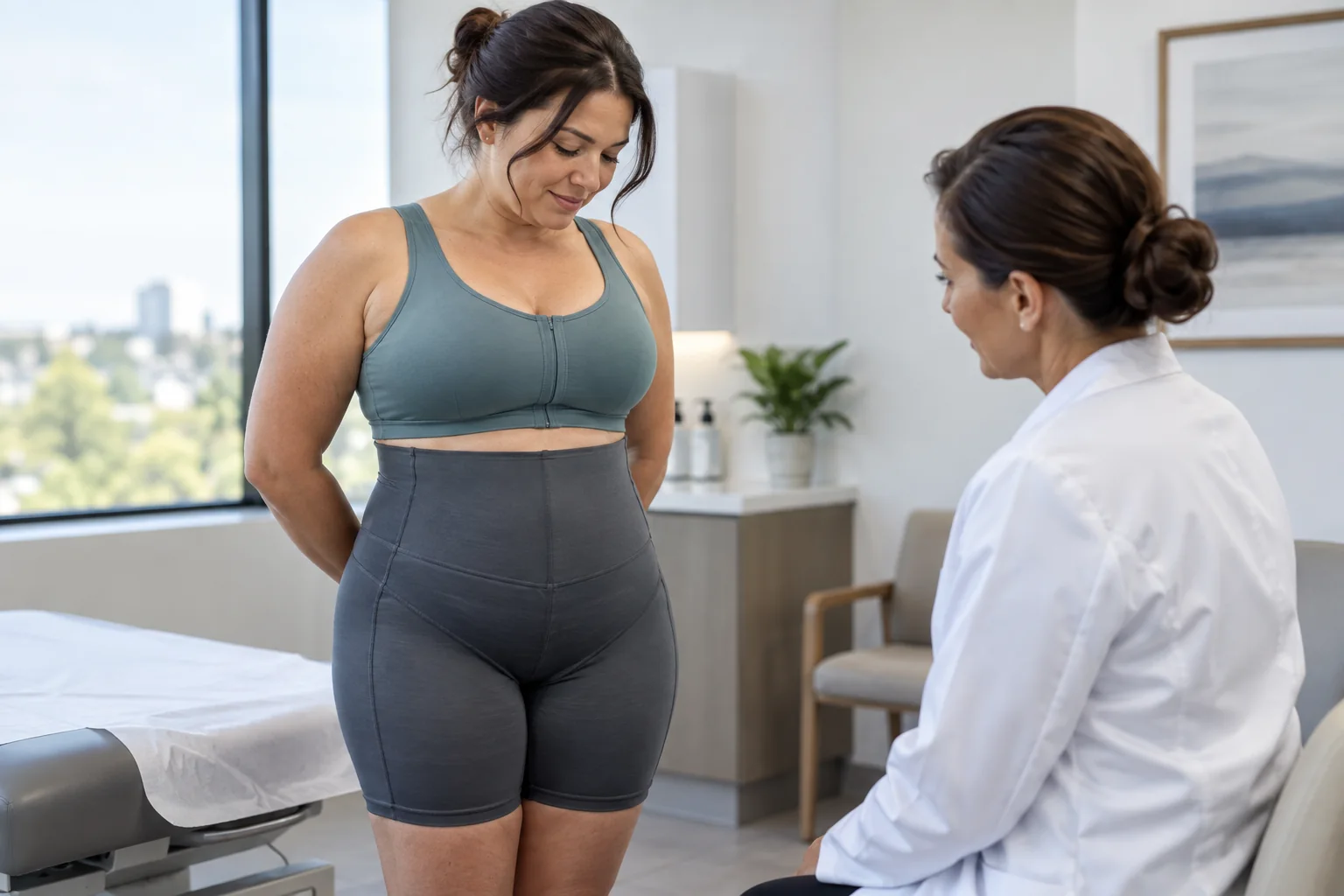
The abdomen you see in week two is not the abdomen the operation produced. It is that abdomen plus tummy tuck swelling. People who have just had surgery often read the fullness as fat that was missed, or as a result that has already failed. Most of the time it is oedema: the ordinary fluid response of tissue that has been cut and lifted. It goes down slowly, and not in a straight line.
Why oedema happens
Surgery injures small vessels and leaves a space under the skin flap. The body sends fluid into that tissue. Gravity pulls it downward, which is why the lower abdomen and the area just above the scar often look the fullest. Standing and walking push more fluid into the area you can see. Lying down lets some of it redistribute, which is why mornings can look better than evenings.
This is not a weight change you can diet away in a week, and it is not a reason to start a new exercise plan against instructions. The fluid is in the tissues. The scales may move a little. The mirror moves more. Neither is a measurement this page can turn into a target.
Typical timeline
| Period | Often described | Easy misreading |
|---|---|---|
| First 2 weeks | Obvious fullness, tightness, garment marks | “This is the final size” |
| Weeks 3–6 | Better in the morning, fuller by evening | “It has all come back” |
| Months 2–6 | A slower change; the shelf softens | “Nothing more will change” |
| Later in the first year | The contour is closer to settled | “Every abdomen looks the same by month three” |
There is no confirmed source on this site that says a fixed percentage of swelling has gone by six weeks. Treat any such figure, if you see it elsewhere, as a slogan until you can see the study. What this page will say is qualitative, and it matches the way the early months are described on the timeline: the biggest change is early, and the last of the fullness is slow. A picture taken while you are still swollen cannot show the settled waist.
Swelling above the scar
The shelf is the pattern that generates the most alarmed messages. Above the scar, a roll or a step appears. Below the scar, the skin can look tighter. The step is where the closure, the swelling, and sometimes a difference in skin thickness all meet. It can look as if the operation stopped halfway. In many people that shelf becomes less sharp as the fluid leaves and the scar softens. It can take months. It does not always disappear completely. A small lasting difference in contour is possible. A shelf that is new today, hot, and painful is not the same finding as a shelf that has been slowly softening for weeks.
Compression and rest
Teams commonly ask you to wear a compression garment and to balance short walks with rest. The garment supports the flap and makes the swelling less uncomfortable for some people. It is not a pump that empties the abdomen on a timetable. Rest matters because doing too much, too early, often makes the evening swelling worse. “Rest” does not mean staying in bed without moving. Stillness for many hours is its own problem, which is why short walks are part of the early plan on the timeline page.
Salt, heat, and long days on your feet are often blamed for a puffier evening. Those are everyday observations, not a study this page can cite. Use them as reasons to be patient with the mirror, not as a diet to invent. If you were given a garment, wear that one. Buying a tighter girdle because you are unhappy with week-three swelling can mark the skin and does not speed biology.
When swelling is a warning sign
General swelling and a collection are different. A haematoma is blood in the tissues. A seroma is fluid. Both are among the local complications named in a review of abdominoplasty1. The review’s overall finding is that about 10% to 20% of patients have a local complication, and fewer than 1% have a systemic one1. It does not split that range into a swelling percentage. A meta-analysis that compared drains and stitching techniques found no significant difference in seroma between the combinations it studied2. That is about technique, not about whether your swelling today is safe to watch. How a seroma feels, and how it is treated, is on the drains and seroma page.
Seek help the same day if:
- the abdomen swells quickly, over hours rather than over a day of being upright
- one side is newly hard, tight, and painful
- the skin is pale, blistered, or breaking down
- you have a high temperature, or the skin around the wound is rapidly more red
- you are breathless or have chest pain
When to get help: contact your GP or NHS 111, or call 999 in an emergency. Do not try to decide between haematoma and seroma yourself. The recovery section is for the ordinary course. A sudden change belongs with a clinician who can examine you.
Frequently Asked Questions
-
How long does swelling last after a tummy tuck?
Tummy tuck swelling is usually at its most obvious in the first weeks, and it often changes through the day for much longer. Many people still notice fullness in the evening, or after they have been on their feet, well after the wound looks closed. The settled contour is a matter of months, not of the first follow-up. This page does not give a week when a set share of the swelling will have gone, because the confirmed sources do not. An early photograph is a photograph of swelling as well as of surgery.
-
Is a hard ridge above the scar normal?
A shelf of swelling just above the scar is common. The lower skin has been tightened, fluid sits where drainage is sluggish, and the join itself is firm at first. That ridge often softens over the following months. A shelf that appears suddenly, or one side that becomes much larger, harder, and more painful than the other, is a different pattern. It can be blood or fluid. Contact your GP or NHS 111 rather than deciding it is the same shelf you had yesterday.
-
Does a compression garment stop swelling?
A compression garment is commonly used to support the abdomen. It does not switch swelling off, and this page does not cite a product that removes a percentage of fluid. Wear the garment you were given, in the way you were shown. If it digs in, marks the skin deeply, or makes breathing uncomfortable, ask the team. Taking it off for days because the abdomen still looks swollen is not a fix. Swelling going down is slow even when the garment is worn properly.
-
How can I tell swelling from a seroma?
Ordinary swelling is diffuse. It is often worse later in the day and a little better in the morning. A seroma is a pocket of fluid. It can feel soft, wavy, or sloshy under the skin, sometimes in one area rather than across the whole abdomen. You cannot confirm that by pressing at home. The difference, and how a clinician drains a seroma, is explained on the drains and seroma page. Do not try to aspirate it yourself.
-
When is swelling a reason to call for help?
Call the same day if swelling increases quickly, if one side becomes tight and painful, if the skin becomes pale or blistered, or if you have a high temperature or feel suddenly unwell. Call 999 for chest pain, severe breathlessness, or bleeding that will not stop. Contact your GP or NHS 111 when you need urgent advice and it is not a 999 emergency. Slow, even, end-of-day puffiness can go to a planned review. A sudden change should not.
-
Will the swelling come back if I exercise?
Activity often makes the abdomen look fuller for the rest of that day, especially in the first months. That rebound is a reason teams limit exercise early, not proof that the operation has failed. This page does not clear you to return to a particular sport on a particular week. Follow the limits you were given. If a workout is followed by a one-sided, painful swelling rather than a general fullness, get it seen.