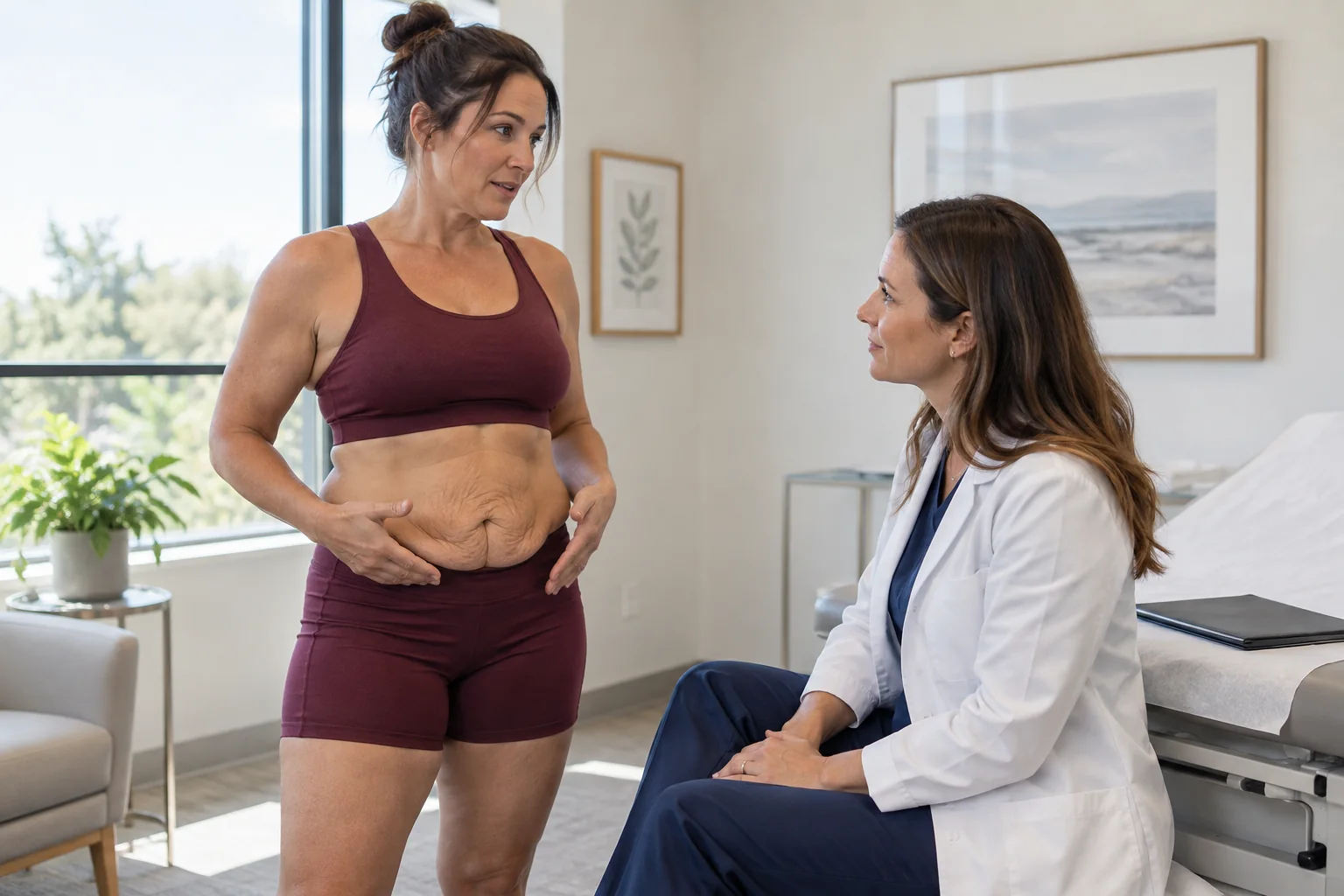
Why skin does not always shrink back
Skin stretches when the body is larger for a long time. After the volume underneath it falls, the skin does not always shrink to match. Some people are left with a fold or an apron at the abdomen. Others notice looseness at the arms, the thighs, or the chest. How much remains is individual. This site does not give a percentage of people who will have loose skin, because it does not have a figure it can stand behind, and because a percentage would not tell you about your own body.
The route to the weight loss does not decide the skin question by itself. A loss from changes in eating, a loss after bariatric surgery, and a loss while taking a medicine a doctor has prescribed can all leave redundant skin. This page will not name those medicines, will not discuss doses, and will not suggest a drug. It will not tell you to lose more weight. If you are still being treated for weight, that treatment stays with the clinician who knows you. The only subject here is what can be done about skin that is already in the way.
Loose skin is not a failure of the weight loss. Framing it as a flaw to be corrected is unfair, and this site will not do that. The practical questions are whether the skin is causing a health or hygiene problem, whether any operation makes sense, and whether the weight is steady enough for a surgeon or a health board to consider it.
The operations involved
Several operations are talked about under one loose phrase, “skin removal”. They are not the same. An apronectomy removes the hanging apron of skin and fat. It does not, as a definition, tighten the abdominal muscles or move the umbilicus. A tummy tuck, or abdominoplasty, can include those extra steps. Which one is being discussed should be explicit before anyone talks about funding or about a quote.
This site goes into the abdominal operations. It does not try to be a full guide to arm, thigh, or chest surgery. If the skin that troubles you is mainly on the abdomen, start with excess skin, which sets out where folds gather, what problems they cause, and how the abdominal choices differ. Read that page before you assume one operation treats every area.
Nothing here ranks surgeons or hospitals. Nothing here is a recommendation that you should have surgery. Some people live with redundant skin and do not want an operation. That is a complete answer.
Why weight must be stable first
Surgeons and, in England, integrated care boards usually want the weight to be steady before skin is removed. The reason is practical. If the weight is still falling or rising, the skin that is left after surgery may not match the plan, and a health board’s policy may simply not allow the referral yet. What “steady” means is written in that policy or in the surgeon’s own criteria. This hub does not invent a number of months or a number of kilograms.
The detail sits on weight stability. That page explains why the question is asked and how to document the record you already have. It does not contain a food plan or a weight to reach. If you wanted a plan for further loss, this is the wrong section of the site.
NHS or private?
Funding and fees are different subjects from the operation itself. On the NHS, cosmetic contour is not a routine entitlement. A documented problem from redundant skin may be considered under a local policy, and policies are not the same in every area. The NHS page is the place for that distinction. It does not promise that any named person will be funded, and it does not print a body-mass figure for you to chase.
If you pay privately, the fee this site uses is explained on the cost page, not here. This hub does not repeat a price. Paying privately does not turn an NHS refusal into a clinical recommendation, and an NHS discussion does not set a private fee.
Choose the next page for the question you actually have: the operation, the timing, the local NHS policy, or the private fee. The cards below are those doors. They are not a ranking, and they are not a treatment plan.