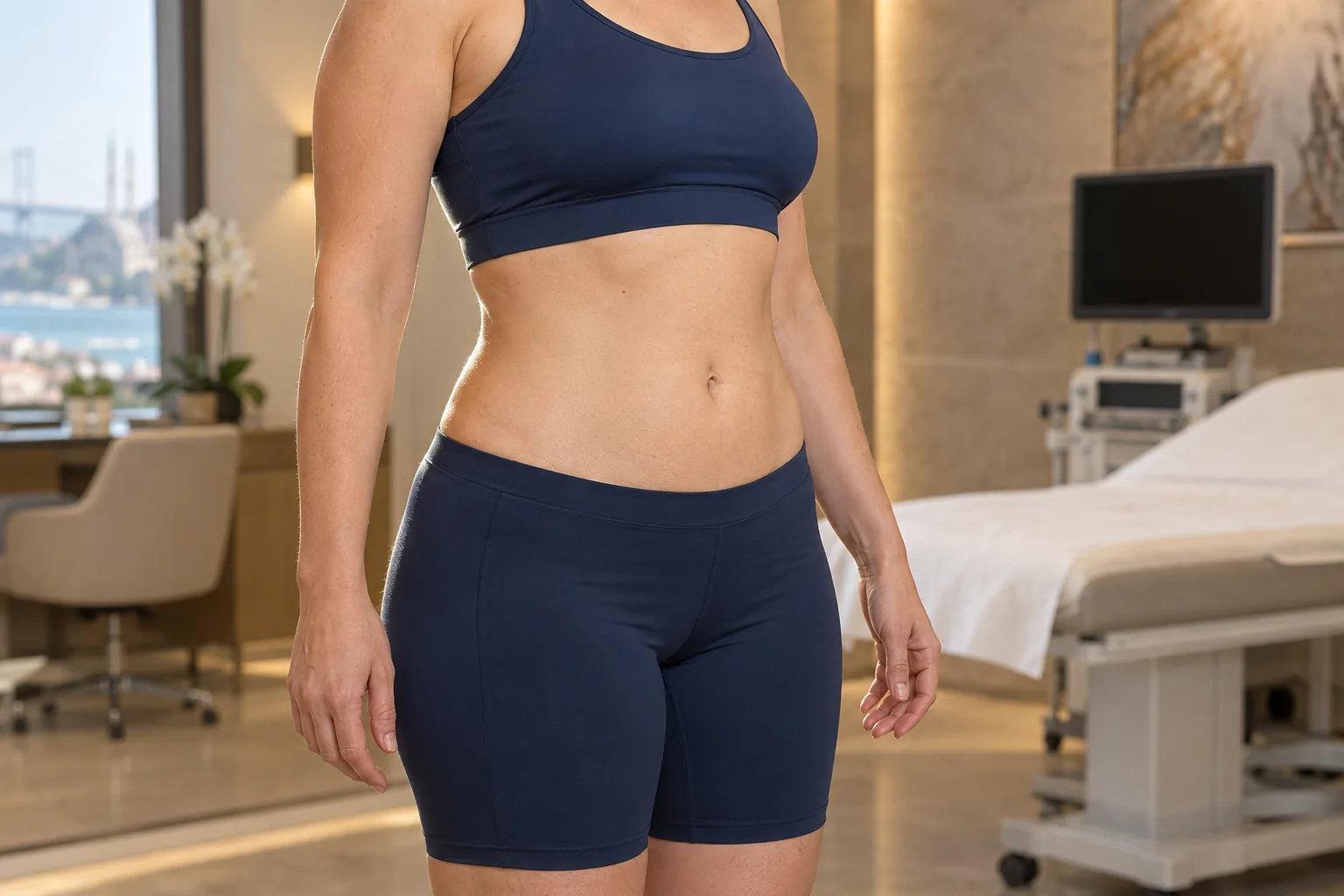
Extended is a useful word only if you ask extended from what. The starting point is a full tummy tuck. The change is how far the scar travels. It is not a new category of surgery with its own biology. It is the same abdominal operation, carried out far enough to catch skin that sits on the flanks.
What it covers
The abdomen is covered in the way a traditional tummy tuck is covered. StatPearls describes that operation as one that removes excess skin and subcutaneous fat and, when indicated, tightens the underlying muscle1, through a horizontal incision, with the umbilicus transposed1. An extended tummy tuck keeps those front steps. The incision then runs further lateral, toward or onto the flanks, so a roll at the side is in the excision rather than left as a step-off beside a shorter scar.
The flank is the soft side between the ribs and the hip, where skin and fat can hang after weight change even when the middle of the abdomen has been discussed already. Liposuction of that fat is a different tool. It does not remove skin that has lost recoil. If the side problem is skin, lengthening the tummy tuck scar is the operation that takes the skin. If the side problem is a small fat bulge under tight skin, lengthening the scar is the wrong tool. That distinction is the subject of tummy tuck versus liposuction.
A mini tummy tuck is the short version at the other end. It uses a shorter lower incision and does not reposition the umbilicus1. Extended is longer than a full scar, not a mini that has been stretched a little. People with laxity above the belly button and out to the sides are not mini candidates.
Who it suits
It suits an abdomen where the looseness or the bulge does not stop at the front of the hip. You can see it when a standard tummy tuck scar, drawn in your mind from hip point to hip point, would end in the middle of the problem. The side would still hang. Extending the drawing is how that side is included.
It does not suit someone whose skin laxity is only a lower central fold. Extra scar on the flank, with no flank skin to remove, is a longer mark for no gain. It also does not suit a lower-back roll. Stopping at the flank is the definition of extended. Going on around is a 360 tummy tuck. Weight stability matters for the same reason as any skin excision: the pattern is cut to the skin you have now. No BMI is printed here.
Look at yourself from the side and from behind, not only in a front-facing mirror. A roll that appears when you turn, at the outer hip, is the finding that makes a standard full scar look too short on a drawing. A roll you can only pinch on the lower back, once the flanks are lifted in your hands, is no longer an extended question. Clothing hides this. A surgeon who marks you in underwear, standing, is in a better position to see it than a photograph taken sitting down. If you have lost a lot of weight, say so. The flanks after a large loss are a different shape from the flanks of someone who has always been a similar weight and simply dislikes a hip bulge of fat.
Scar length
The scar is low, as a full tummy tuck scar is low, and it is longer. How much longer depends on how far the flank skin extends. A number of centimetres would pretend every flank is the same width. The ends of the scar are the part people notice in a fitted top or from the side. They can sit slightly higher than the middle of the scar. That is a reason to ask to see the planned line marked on you, standing, not a reason to expect the ends to hide perfectly.
There is no vertical component in the standard extended plan. If someone describes an extended fleur-de-lis, they are combining two extensions: sideways and upright. Get them to say which lines will actually be there. Scar care over the following months is the same kind of maturation as any abdominal scar. Details are on scar healing. This page does not promise the longer line fades faster because it is lateral.
Extended vs 360 vs fleur-de-lis
Three names, three directions. Extended goes sideways and stops. A 360 goes around. Fleur-de-lis goes up the front. The table is the simplest way to hold them apart. None of the cells is a fee, and none is a recovery time in weeks.
| Extended | 360 | Fleur-de-lis | |
|---|---|---|---|
| Extra skin removed | Flanks | Flanks and lower back | Side-to-side laxity on the front |
| Scar | Longer low horizontal scar | A belt around the trunk | Horizontal scar plus a vertical midline scar |
| Back included | No | Yes | No |
| Upright scar on the front | No | Not by this name | Yes |
Read fleur-de-lis if the upright scar is the trade you are weighing, and the 360 page if the back is in the pinch test. All types keeps the wider map, including mini and apronectomy, which solve still different problems.
Recovery
The wound is longer than a standard full tummy tuck, so the uncomfortable zone reaches further toward the hips. Swelling can collect at the ends of the scar. Turning in bed catches the sides. None of that is a published week count. Drains, when used, follow the same general abdominoplasty practice: one or two are typical, and they are not mandatory1. A garment that reaches the flanks is commonly advised. The shared timetable language, such as it is, lives on recovery.
Seek help for sudden breathlessness, chest pain, a temperature, spreading redness or a wound that opens. GP, NHS 111, or 999 in an emergency. This page cannot assess a scar from a message.
FAQ
-
How is an extended tummy tuck different?
An extended tummy tuck includes the flanks as well as the front of the abdomen. The horizontal scar is longer than a standard full tummy tuck and runs out toward the sides. Muscle may be tightened when indicated, and the umbilicus is usually moved, because the front is still a full abdominoplasty. It does not continue across the lower back. That further step would be a circumferential, or 360, plan.
-
How long is the scar?
Longer than a standard full tummy tuck, because it has to reach the flanks. It is still one low scar, not an upright scar on the front and not a belt around the back. This page does not give a length in centimetres. The length is whatever is needed to remove the side skin that was the reason for extending it. A scar that runs further than the loose skin requires is an extension without a target.
-
Who needs one?
Someone whose loose skin or bulge continues from the abdomen onto the flanks, so a scar that stops at the front of the hip would leave those sides untreated. A small fold only under the belly button does not need the extra length. A roll that continues across the lower back needs a different operation again. The flank is the deciding area, not a wish for a more thorough package.
-
How does an extended tummy tuck compare with a 360 tummy tuck?
Extended stops at the flanks. A 360 tummy tuck carries the scar around the lower back so the operation is circumferential. If you can pinch a fold on the front and sides but the lower back is smooth, extended is the closer match. If the fold goes all the way round, stopping at the flank leaves the back. The 360 page explains what circumferential is actually asking you to accept.
-
How does an extended tummy tuck compare with a fleur-de-lis tummy tuck?
Extended adds length to the horizontal scar so the sides are included. Fleur-de-lis adds an upright scar on the midline so skin can be pulled from side to side on the front. One scar hides, as far as a low line can, toward the hips. The other is visible when you look down. They solve different directions of looseness. Some abdomens have both problems, which is a planning question, not a reason to stack names.
-
What does recovery involve after an extended tummy tuck?
A longer wound than a standard full tummy tuck, swelling that can sit out toward the hips, and the same early limits on lifting. This page does not state a week of downtime or a hospital stay. Drains are commonly discussed in abdominoplasty and are not mandatory. The recovery page covers the shared outline. Chest pain, sudden breathlessness, a high temperature or a wound that opens should go to your GP, NHS 111, or 999.