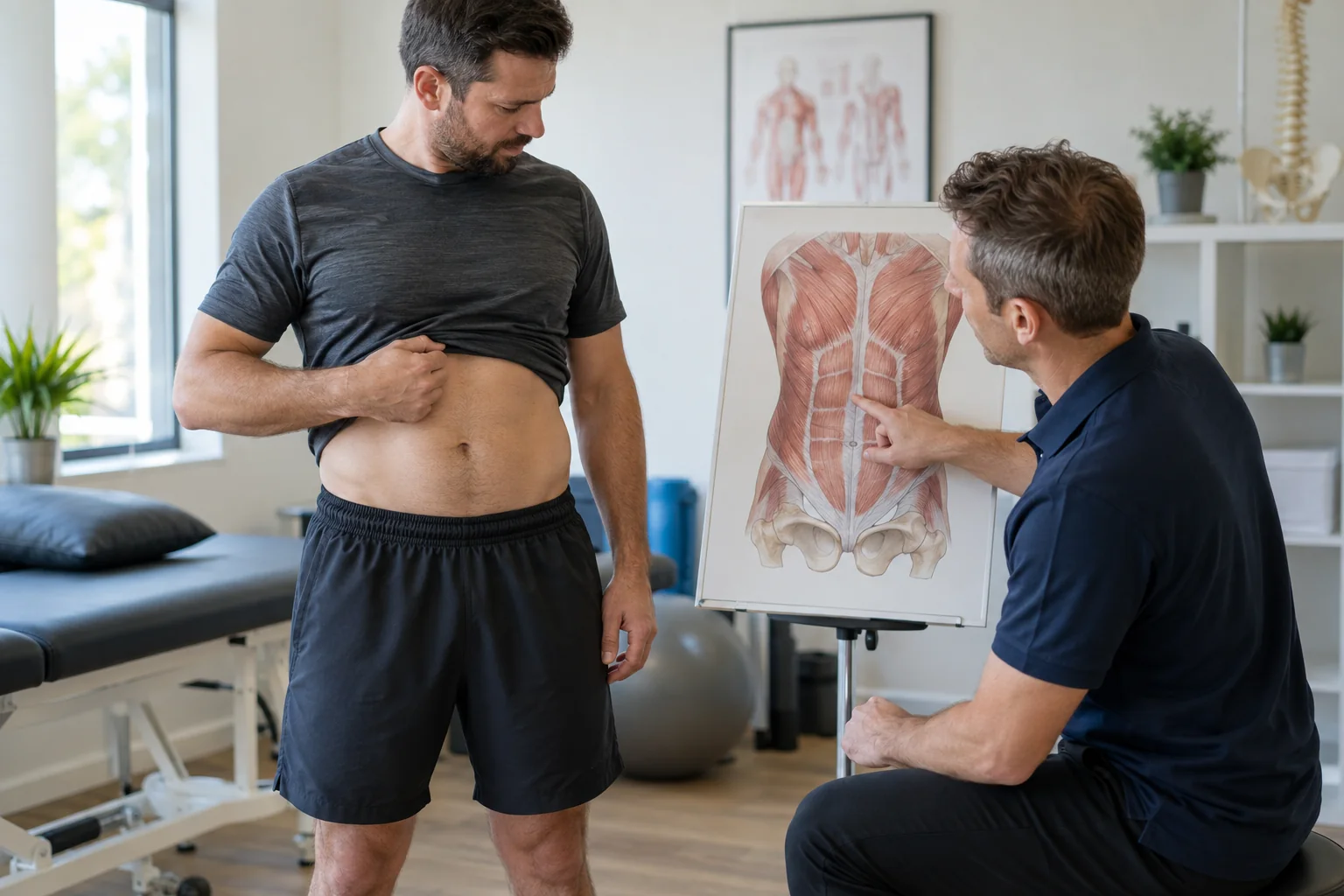
Most explanations of a separated abdominal wall are written around pregnancy. That leaves men who can see a ridge or a gap with nowhere sensible to read. Diastasis recti in men is the same anatomical finding: the two vertical rectus muscles sit further apart than they should, along the midline. What differs is often the history people bring to the appointment, not the muscle itself.
This page is about when surgery is considered. It is written from the tummy tuck side of that decision, because that is the operation this site explains. The overview of plication is on the muscle repair page.
What it is and why men get it
Stand in front of a mirror and lift your head and shoulders off the bed. Some men see a domed ridge down the centre of the abdomen. Others feel a soft gap between two firmer bands of muscle. That is the finding people mean when they ask about diastasis recti in men. The connective tissue between the rectus muscles has stretched. The muscles themselves are still there.
Three histories come up again and again. One is years of heavy lifting, in the gym or at work, with the abdomen braced hard. One is a large change in weight, up or down, so the abdominal wall has been stretched and then left slack. One is a family tendency: other relatives have the same midline gap. These are reasons to be assessed. They are not diagnoses, and this page does not cite a share of men for each of them. The sources used here do not report those shares.
Pregnancy is not a requirement for the finding. Saying that does not make a male gap a different condition with a different name. It means the explanation should not stop at childbirth. If your history is none of the three above, that also does not rule the finding out. A clinician still has to look.
How it is assessed
Assessment is an examination, not a search result. The clinician looks at the abdomen at rest and as you raise your head, feels the gap, and checks whether there is a true defect rather than a widening only. Skin laxity, scars from earlier surgery, and a cough impulse are part of that visit. A photo taken from above, in bathroom light, cannot do this.
You should say if you smoke, if you have had a blood clot, and if you take medicines that affect bleeding. You should also say what you want to change. Some men want the ridge gone. Some want loose skin gone after weight loss. Some want both, and have not separated the two. Those are different operations, which the next sections keep apart.
This page does not print a centimetre at which surgery "starts". A number without an examination would be a rule this site invented. Severity, and what to do about it, is the subject of the diastasis repair page. The men's question is the same measurement problem, asked by a group that leaflets often skip.
When surgical repair is considered
Surgery is considered when a clinician has examined you and judges that tightening the midline, sometimes together with removing skin, fits the problem in front of them. A gap you noticed in the gym is not that judgement. Neither is embarrassment on its own, and neither is a wish to "get ahead of it" without being seen.
It is also considered against the risks of an operation. A literature review of abdominoplasty reported local complications in about 10% to 20% of patients, and systemic complications in fewer than 1%2. Those figures describe tummy tuck surgery in the studies the authors reviewed. They are not a rate for diastasis recti in men, and they are not a promise that a smaller repair sits at the bottom of the range. They are a reason to treat "it's only a stitch in the muscle" as an incomplete account.
Reasons to wait are ordinary and not a criticism. You have not been examined. You smoke and have not discussed stopping. You have a history of clots and no plan for how that risk would be handled. Your weight is still changing quickly. You cannot say who will see the wound afterwards. None of these is a moral point. Each one is a reason the operation may be the wrong time.
Repair with or without a tummy tuck
According to the StatPearls chapter on abdominoplasty, a tummy tuck is designed to improve abdominal contour by removing excess skin and subcutaneous fat and, when indicated, tightening the underlying muscle1. For a man with both loose skin and a midline gap, that is the operation in which repair is usually discussed: skin removed, and plication added because the muscle layer is part of the problem.
Repair without a tummy tuck is a different conversation. The midline can be tightened without taking a sheet of skin away. That does not deal with an apron of skin left after weight loss, and it does not move the belly button in the way a full tummy tuck does. If skin is the thing you dislike when you look down, a muscle-only plan will not answer it. If the ridge is the thing you dislike and the skin is not loose, a full tummy tuck may be more operation than the finding requires. The surgeon has to say which of those is you.
Get the plan in one sentence. "Plication of the rectus muscles, with skin excision" is one operation. "Plication without skin excision" is another. What a tummy tuck does is the skin-and-muscle overview. This page does not describe a scar pattern for a repair done on its own, because the sources used here describe abdominoplasty, not a standalone technique.
NHS position
Whether the NHS will fund an operation for diastasis recti in men is not settled by this page. A cosmetic tummy tuck and an operation for a functional problem are different requests, and local policy is not something this site should paraphrase from memory. Read the NHS funding page before you assume you will be accepted or turned away.
Being male is not a separate price category here, and this page does not print a fee. If you are paying privately, the fee guide is where the method is explained. Do not expect a men's discount, or a men's surcharge, to appear on this site.
If you are unwell after an operation, the route is the same as for anyone else. Contact your GP or NHS 111 about a wound, a temperature, or a new one-sided swelling. Call 999 for sudden breathlessness, chest pain, or bleeding that will not stop. That advice does not depend on whether the NHS funded the surgery.
Frequently asked questions
-
Can men get diastasis recti?
Yes. Diastasis recti in men is a widening between the rectus muscles in the midline, and being male does not rule it out. A clinician assesses the gap in person. This page does not give a percentage, because its sources do not report one for men. Plication is explained on the muscle repair page.
-
Does it need surgery?
Not always. A gap is not an instruction to operate. Surgery is considered when a clinician has examined you and judges that repair, with or without a tummy tuck, fits the problem you have. Many people are assessed and not offered an operation. When surgery is not the next step is set out on the diastasis repair page.
-
Is it the same as a hernia?
No. A hernia is a defect in the abdominal wall that tissue can push through. A diastasis is a widening between the muscles, and a hole is not assumed. The two are easy to confuse on sight, so a clinician has to tell them apart. This page does not describe hernia repair and does not give a rate for either finding.
-
Can repair be done without a tummy tuck?
It can be discussed on its own, and it can be done as part of a tummy tuck. They are not the same plan. A tummy tuck removes skin and can include muscle tightening when that is indicated. A repair on its own does not, by itself, remove an apron of skin. Ask which operation you are being offered before you compare scars.
-
Will the NHS fund this for men?
This page does not decide that. A cosmetic tummy tuck and a functional problem are different requests, and funding in England is not a single rule printed here. Read the NHS page before you assume a yes or a no. Being male does not create a separate price on this site, and no figure is printed here.
-
What happens at an assessment?
A clinician examines the abdominal wall. The gap, the skin, and the question of a hernia are part of that visit. A photograph is not a substitute. Say if you smoke, if you have had a blood clot, and what you want surgery to change. If a tummy tuck is what you are offered, the recovery page describes the early weeks.