The short answer
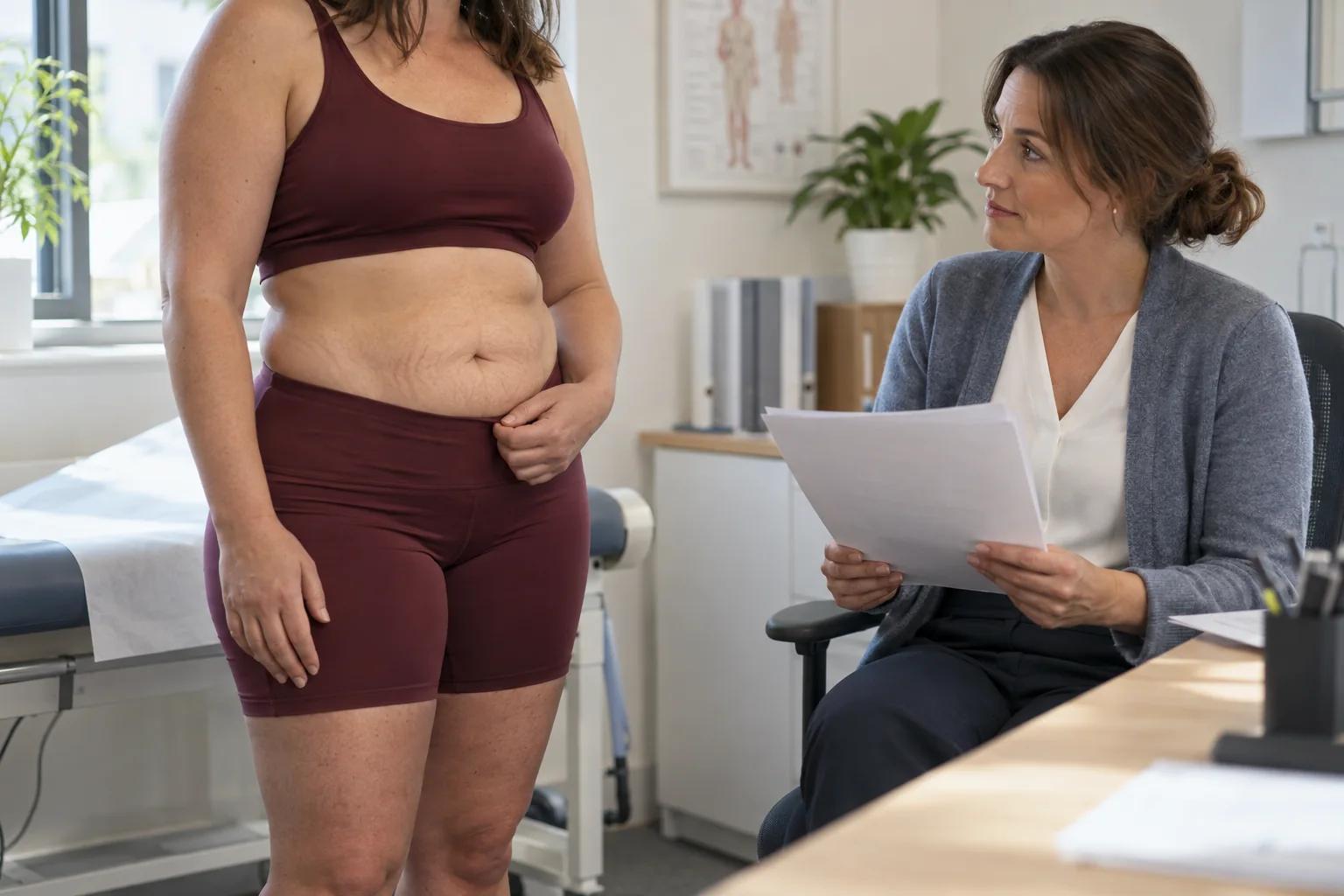
For a cosmetic change in shape, no. NHS.uk says an abdominoplasty is regarded as cosmetic surgery, so it is not usually available on the NHS3. If there is a documented functional problem, some integrated care boards may fund skin removal. A tummy tuck on the NHS is therefore not a yes-or-no fact about the whole country. It is a question about the policy that covers your GP’s patients, the operation that policy actually names, and whether a clinician judges that you meet it.
This site is not the NHS. It does not see your records, it does not rank hospitals, and it cannot tell you that you will be approved. Integrated care boards commission services in England. Scotland, Wales, and Northern Ireland use their own bodies, so an English PDF is not their rule.
If the NHS route is not open to you, paying privately is a separate decision. The fee this site uses is explained if you pay privately. Whether a private policy contributes is covered under private medical insurance. A private fee is not an NHS price.
Where the line is drawn: cosmetic vs functional
In surgical terms, a tummy tuck is an abdominoplasty. A standard reference describes it as an operation that removes excess skin and subcutaneous fat and, when indicated, tightens the underlying muscle1. In the traditional form, the same source says the operation transposes the umbilicus1. Those sentences describe what the surgery can do. They do not say that a health service will pay for it.
The line readers are usually asking about is different. One request is about appearance: loose skin or a changed contour that bothers someone, without a health problem the local policy recognises. Another request is about function: a fold of skin that is inflamed, repeatedly infected, ulcerated, or difficult to keep clean, with that history written in a clinical record. NHS bodies draw funding lines around the second kind of problem more often than the first. How they draw it, and what evidence they want, is not identical from board to board.
The research literature makes a related distinction, and it should not be misread as an NHS statistic. A 2022 analysis of American College of Surgeons records compared 6,397 functional panniculectomies with 4,740 cosmetic abdominoplasties2 performed from 2015 to 2019. The functional group had more other illnesses, and adverse events were higher. That is a United States hospital database. It is not an NHS complication rate, and it is not proof that any English board will or will not fund you.
What the comparison does support is simpler. Removing a heavy apron of skin from someone with medical problems is not the same label as a cosmetic abdominoplasty. If you are discussing excess skin after weight loss, use the words your policy uses, and ask which operation is actually being proposed.
| Question | Appearance | Function |
|---|---|---|
| What is being asked for | A change in contour | Relief from a skin problem the policy recognises |
| Typical operation names | Abdominoplasty, tummy tuck | Apronectomy or panniculectomy, if the policy uses those words |
| Muscle and umbilicus | May be part of a full abdominoplasty | Not assumed. Read what the policy actually funds |
| Who decides | Not a routine NHS commission | Your board’s policy, then a clinician |
| What this page will not do | Call a cosmetic request an entitlement | Promise funding to a named person |
What ICBs typically require
Policies often look at the same kinds of facts: body weight and how long it has been steady, skin problems written in the notes, treatments already tried, time since a large weight change or a pregnancy, and smoking. That list is a map of topics, not a national checklist you can tick and send. Policies differ by integrated care board. Three dated policies, with different body mass index lines, are set out on how to read an ICB policy. They are examples. They are not your rule unless that board covers your GP.
BMI thresholds and weight stability
Some policies include a body mass index figure, a period of stable weight, or both. This page does not print either as a number. A threshold copied from another board is not your rule. What “stable” means is the definition in your own policy. Check your integrated care board.
Documented skin problems
Readers often mention soreness in a fold, recurrent infection, ulceration, or difficulty with hygiene. A policy is usually interested in problems that have been documented in the GP record, not only described at one appointment. This page does not say how many infections are enough. The examples a policy accepts are listed in that policy. If the skin is worsening now, speak to your GP.
Conservative measures tried and recorded
Many policies ask what has already been tried: washing and drying the fold, reducing rubbing, and prescribed treatment for inflamed skin. This site will not give you a skincare regimen. What must have been tried is a line in your board’s policy. A routine that never entered the GP record may not count. Policies differ by integrated care board.
Time since major weight loss or pregnancy
After a large drop in weight, or after pregnancy, policies often want time to pass, because the weight may still be changing. The length of that gap is the period printed by your board. This page does not replace it, and it does not set a weight to aim at. Take dates already in the GP record, and read the timing section of the policy.
Smoking status
Some documents ask for non-smoking status, a recorded stop, or a test. This page does not invent that period. If you smoke, ask your GP what the policy counts as evidence. A stated intention is not the status the PDF requires. The wording that applies is your board’s.
Why criteria differ by ICB
Each integrated care board publishes its own clinical policies for procedures it does not offer to every patient. There is no single England-wide tummy tuck rule sitting behind them that this site could quote instead. Two neighbouring boards can describe the same operation and still set different evidence, different exclusions, and different routes for an exception. That is inconvenient. It is also the structure you have to use.
Learn which integrated care board covers your GP practice. Search that board’s website for “abdominoplasty”, “apronectomy”, and “panniculectomy”. Open the PDF, note the date, and read the operation’s section, including exclusions. A forum screenshot is not the policy — use the PDF itself.
Apronectomy vs abdominoplasty on the NHS
A policy may name removal of the hanging apron rather than a full cosmetic abdominoplasty. You only know which by reading it. An apronectomy, also called a panniculectomy in much of the literature, takes away that apron of skin and fat. A full abdominoplasty can do more: it can tighten muscle when indicated and it moves the umbilicus.1 Those extra steps are part of why a board can agree to one operation and not the other.
This site will not tell you that the NHS “usually” funds apronectomy as if that were a national fact. Some policies discuss it. Some exclude it except through an individual request. Some use different words. The only honest instruction is to read the operation named in your PDF, then read what an apronectomy involves so the clinical name and the funding name are not mixed up. The practical route, from GP to a decision, is on the apronectomy pathway.
The American series cited above is useful here only as a reminder that the functional operation and the cosmetic operation were studied as different groups.2 Higher adverse events in the functional group are not an NHS rate. They are a reason to treat the labels carefully when you read a policy or a consent form.
Diastasis recti repair on the NHS
A gap between the straight muscles of the abdomen is called diastasis recti. Muscle tightening can be part of an abdominoplasty when indicated1. That surgical fact is not the same as an NHS funding fact. A board can regard muscle repair done to change contour as cosmetic, even when the person finds the gap distressing, and still have a narrower route for a functional problem.
This page does not set out who “should” have a repair. It does not promise that a symptomatic gap will be funded, and it does not say that funding is impossible. The limits are in the local policy. A fuller explanation of the condition sits on diastasis recti. Take that policy, not this paragraph, to the appointment.
How to ask your GP for a referral
Take a short symptom diary, letters or prescriptions already issued for the skin, and a dated account of weight, including weight-loss surgery or a pregnancy. Take the policy so you and the GP are reading the same criteria. Ask which operation it names, and what the notes still lack. A GP can decide not to refer. This page cannot referee that conversation, and it cannot tell you that you qualify.
Write down the answers in the room: the name of the integrated care board, the title and date of the PDF, and whether the next step is a routine referral or an individual funding request. If the GP has not seen the policy, the appointment can still be used to put the skin problem in the record. A later panel can only use what was written down. Bring photographs only if the GP asks. This site does not ask you to send any.
If you are refused: the appeal route
Where a case falls outside the rules that apply to most people, the formal mechanism in England is often an individual funding request. It argues exceptionality: that your circumstances were not covered by the group the policy already considered. You do not usually submit it yourself. A clinician does. “Exceptionality” is not a synonym for how much the problem matters to you. If you are refused, start with the letter, then read how appeals and funding requests work. That page is not legal advice, and it does not mean the request will succeed.
Waiting times
This page does not give a waiting time in weeks or months. There is no single NHS queue for abdominoplasty that could be printed without misleading people in other areas. NHS England publishes referral-to-treatment statistics for consultant-led care. Those tables are not a tummy-tuck tariff and not a promise that a cosmetic operation sits on the same clock as a funded one. A board that has not agreed to fund the operation is not running a queue for it.
A referral is not a date for surgery. Time can pass while notes are gathered, while a policy is checked, while an individual funding request is considered, and while a surgical list runs. If a hospital gives you a written wait, that letter is the figure that applies to you. Ask what the letter is counting: an outpatient opinion, or an operation date. If symptoms worsen while you wait, contact the GP or the service holding the referral. Do not use a national average in place of that letter.
Frequently asked questions
-
Can you get a tummy tuck on the NHS?
A tummy tuck on the NHS is not funded to change appearance alone. Some integrated care boards will look at skin removal when their own functional criteria are met, such as a skin problem written in the GP record. Boards do not share one rule. Nothing on this page is a promise that the NHS will fund a named person. Read the policy for your own board before you assume a yes or a no.
-
What BMI do you need for NHS skin removal surgery?
There is no single BMI for NHS skin removal surgery that this site can honestly print. Integrated care boards publish their own clinical policies, and a figure used in one area is not a national rule. This page does not state a BMI number for that reason. The criteria guide explains how to find your board's policy and how to read whatever figure, if any, that document uses.
-
Can you get an apronectomy on the NHS?
An apronectomy removes a hanging apron of skin. It is not the same operation as a full abdominoplasty, which can also tighten muscle and move the umbilicus. Some boards name apronectomy or panniculectomy in their policies. Whether you can have one on the NHS depends on that policy and on a clinical assessment. This site cannot say that your board will approve you.
-
Has anyone had a tummy tuck on the NHS?
This site does not publish patient stories, and a story from another area would not tell you what your board will do. People are sometimes treated when a local policy's functional criteria are met. A request made only to change contour is a different decision. Meeting a description you have read online is not an approval, and this page does not collect before-and-after photographs.
-
What happens if my referral is refused?
A refusal means that request did not meet the policy used for the decision, or that the board did not accept an exception. It is not a ruling on every future request. The next formal route is usually an individual funding request made by your clinician, not by you, or an appeal where the policy allows one. That path is explained on the appeals page. It is not legal advice and it is not a prediction.
-
Can diastasis recti be repaired on the NHS?
Diastasis recti is a separation of the abdominal muscles. Tightening muscle can be part of an abdominoplasty when a surgeon judges it indicated, but that is not the same decision as removing a symptomatic apron of skin. Whether the NHS will fund a repair depends on your integrated care board's policy and on a functional reason that policy recognises. This page does not promise repair for appearance alone.