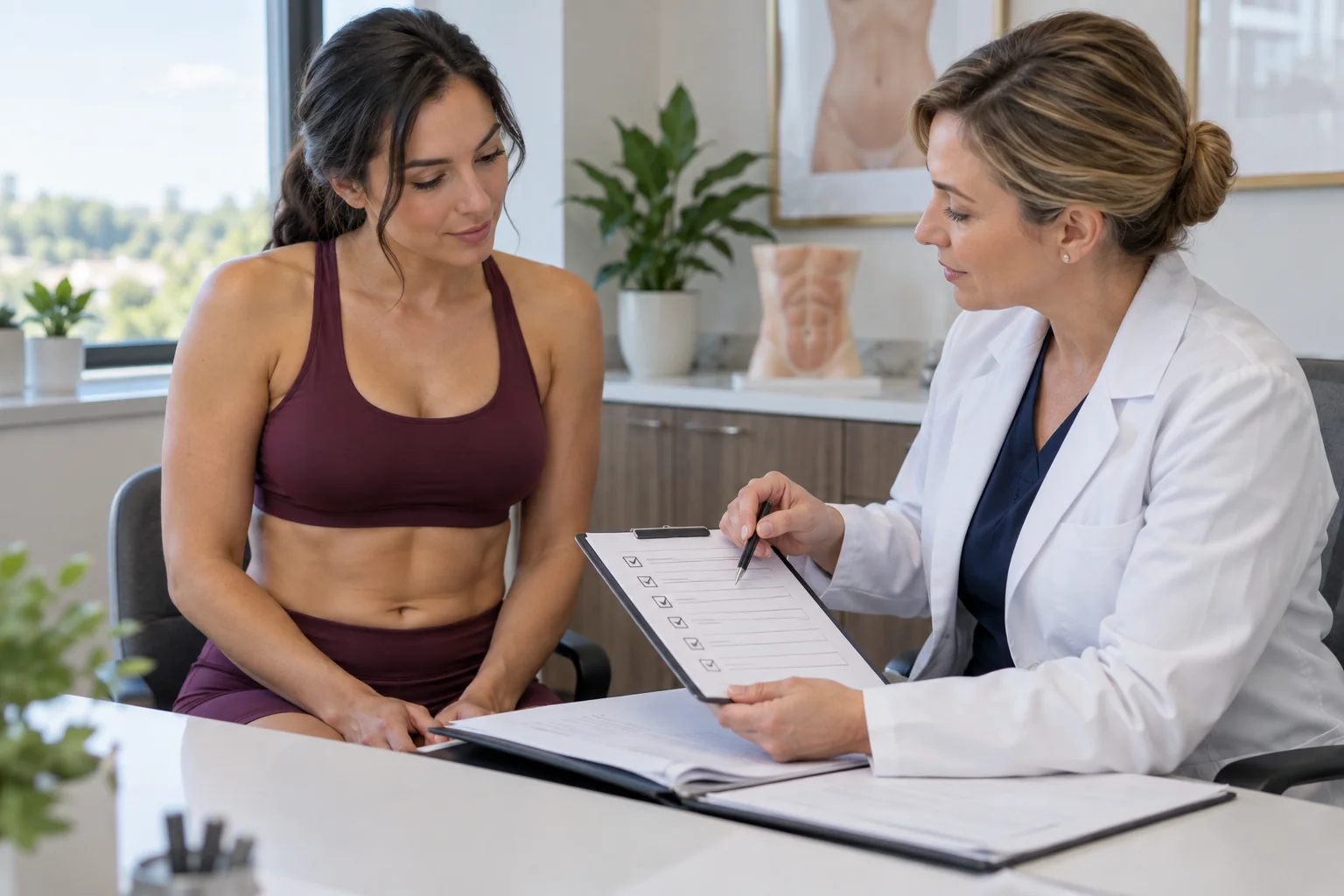
People often arrive at a safety page looking for a yes or a no. The honest answer is narrower. A tummy tuck is a major operation on the abdominal wall. Most published problems are local ones, at the wound and under the skin. Problems that affect the whole body are less often reported. Those statements are unpacked, with the figures that can be cited, on the risks page. They are not repeated here as a slogan.
This site is not a clinic. It cannot tell you that you are fit for surgery, and it cannot assess a wound from a description. The pages below are for reading before you decide, and for understanding the words clinicians use if something is not as you hoped.
When it goes wrong
The phrase people type into a search box usually means an appearance they did not expect: an uneven contour, a scar that is thicker than they hoped, or a pucker at the end of the wound. Those are real disappointments. They are not the same thing as a clot, a bleed, an infection, or skin that has lost its blood supply. Mixing the two makes both harder to understand.
The when a tummy tuck goes wrong page keeps that distinction, explains what can sometimes be revised and when, and sets out a high-level path for raising a concern in the UK. It does not give legal advice, and it does not show photographs of complications.
Pregnancy after
A later pregnancy can stretch skin that was tightened and can affect a muscle repair. That is a reason many surgeons suggest waiting until you have finished having children. It is not a reason to blame someone who becomes pregnant afterwards. Whether a pregnancy is medically straightforward is a question for maternity care, not for a cosmetic-surgery article that has no figure to quote.
The pregnancy after a tummy tuck page stays on that ground: what can change, why waiting is often advised, and what to do if you are already pregnant.
Risks
Tightness, swelling, bruising, and altered feeling are common in the early weeks. They are not the same list as the complications described in the surgical literature. The risks page uses only the complication sources confirmed for this site. It gives the local and systemic ranges those sources support, and it does not invent a percentage for seroma, infection, or scars on their own.
Read tummy tuck risks for that account, including what the drain research does and does not prove.
Am I suitable?
A suitable candidate is usually someone with loose skin, and sometimes lax muscle, who can accept a permanent scar and a recovery measured in weeks and months. Age on its own is a weak guide. Stable weight, smoking, and plans for another pregnancy matter more to the decision than a birthday. Distress about appearance deserves respect, and it is not something this site diagnoses.
Those points are set out on the candidacy page, including when it is wiser to wait.
Questions worth asking any surgeon
A short list is more useful than a tour of regulators. You do not need a second opinion from a website to ask these in the consultation:
- Who do I contact, on a UK number, if I am unwell the night I get home?
- What is the plan for drains, wound checks, and the first follow-up?
- What should I do the same day if I have breathlessness, a high temperature, or a sudden increase in swelling?
- If other surgery is being done at the same time, how does that change the recovery and the risks?
- If I am travelling for the operation, who sees me after I am back in the UK?
Write the answers down. A clear plan for the first fortnight is part of the decision, not an extra. This page does not open a general guide to professional registers, and it does not suggest that any named body endorses this site or a particular clinic.