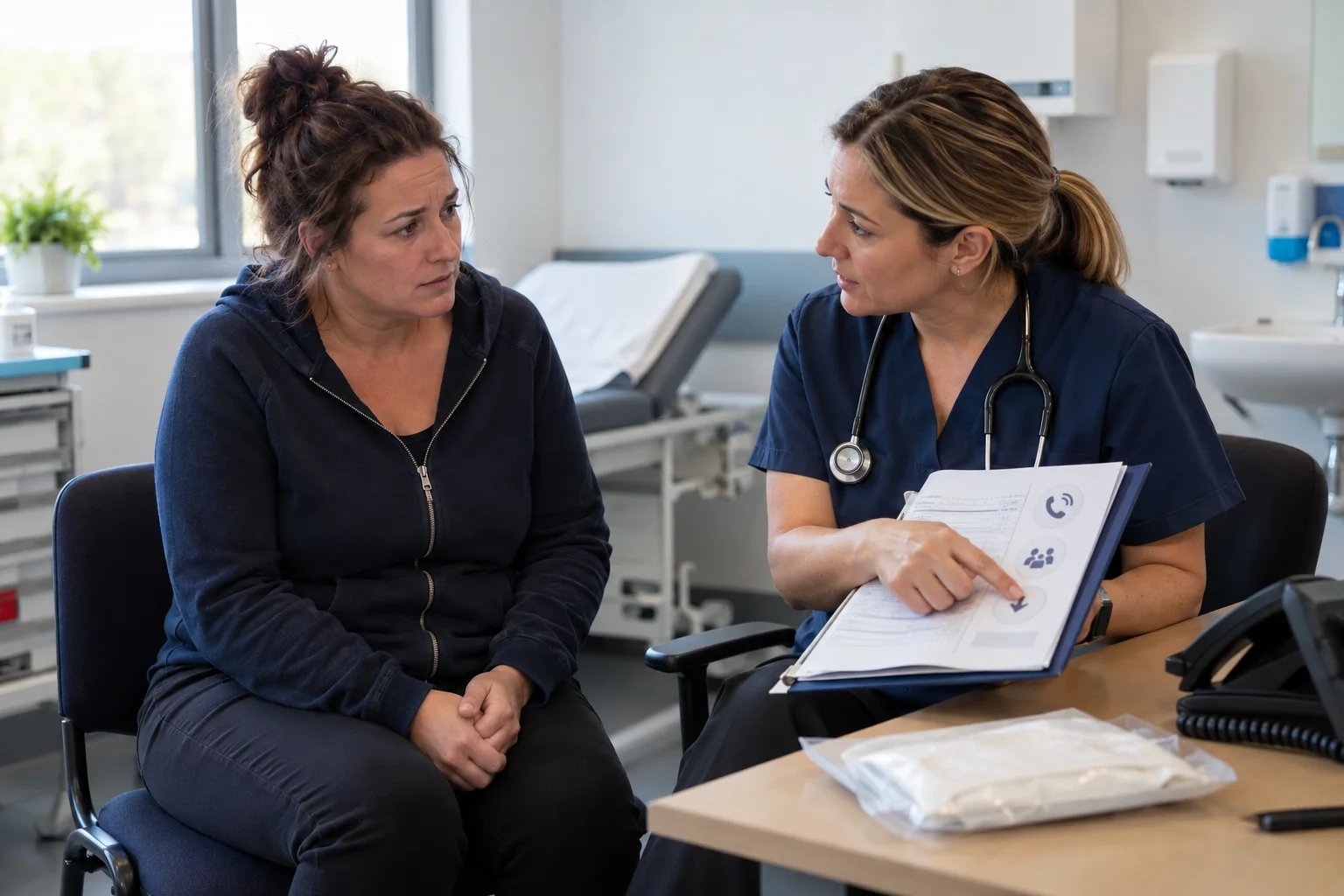
Search results for a tummy tuck gone wrong are a poor teacher. They mix unhappy scars with emergencies, and they reward the most alarming picture. This page will not do that. There are no complication photographs. There is no story told to frighten you, and there is no promise that every disappointment can be stitched into a better one. There is a distinction worth keeping, and a short account of how a concern is raised in the UK.
If you are breathless, bleeding, or feverish while you read this, stop and get help. The paragraphs will still be here.
What “gone wrong” usually means
Most of the time the phrase is about appearance. The abdomen is uneven. One side looks fuller. The scar is wider or higher than you were shown. There is a pucker, a dog ear, at the hip. The belly button looks pinched or off-centre. These are real losses. People plan clothes, confidence, and sometimes a long-saved fee around a result, and a result that is not what they pictured is a genuine harm even when it is not dangerous.
Appearance problems and medical complications overlap, because a scar, a seroma, or a patch of delayed healing can change the contour. They are still not the same conversation. One is about what you see when you are well. The other is about whether you are safe this week. The early weeks of ordinary soreness are on the recovery timeline. Dog ears have their own page, so this one does not need to sensationalise a pucker.
| Appearance | Urgent medical problem | |
|---|---|---|
| Examples | Asymmetry, scar, dog ear, navel shape | Rapid swelling, spreading redness, breathlessness, a wound that opens |
| Timing | Often judged after swelling settles | The same day, or immediately |
| Where to go | The clinic that knows the operation | GP, NHS 111, or 999 |
Serious complications
A literature review of abdominoplasty reports that about 10% to 20% of patients have a local complication, and fewer than 1% have a systemic complication1. The local problems it discusses include seroma, haematoma, infection, skin necrosis, suture extrusion, hypertrophic scars, and umbilical anomalies. The systemic problems it discusses include deep vein thrombosis, pulmonary embolism, respiratory distress, and death. Naming death is not a flourish. It is in the review. It sits inside the systemic group, the group reported in fewer than 1% of patients. It is not the typical meaning of an unhappy search.
A separate meta-analysis, of 4,295 patients, found overall complication rates in the included studies from 9.3% to 33.8%2. Those are rates inside studies, which were selected and which used different techniques. They are not your personal risk, and they are not a reason to treat every operation as a coin toss. The same paper did not find a significant difference in individual complications, including venous thromboembolism, across the drain and suture combinations it compared2. Technique slogans do not replace the headline ranges.
The figures, and what they do not say about smoking or body weight one factor at a time, are written out on the risks page. This page only needs them so that “serious” has a source.
Why outcomes vary
Two people can have the same operation described on a consent form and heal differently. Skin quality, how much tissue was removed, whether muscle was tightened, infection, a haematoma, and the way the scar matures all change what you see at a year. Smoking and a higher body weight are widely treated as reasons wound healing is harder. The sources used here do not give a tidy multiplier for either, so this page does not invent “twice as likely” or any similar line.
That variation is not a verdict on your character. A complication is not proof you failed at rest, or that you deserved a worse scar because you wanted surgery. Explanations help the next decision. Blame does not treat a wound. If a clinic implies that any disappointment is the patient’s doing, ask for the reasoning in writing. You can disagree with a clinical opinion without turning the disagreement into an attack, and without accepting an attack either.
What can be revised and when
Revision is a second operation, or a smaller procedure, aimed at one defect: a dog ear, a high scar, a contour dip, a navel that is very narrow. It is more honest when it is specific. “We will make it like the photograph” is not specific. A reasonable revision conversation names the problem, what tissue is left to work with, what new scar you would accept, and what cannot be changed. Stretch marks on skin that was not removed will still be there. A large weight change later can undo a repair. Those limits are not cruelty. They are the boundary of the operation.
Timing is after the acute problem, if there was one, has healed, and after swelling is no longer pretending to be contour. For a stable appearance issue, that is often months, not the first fortnight. This page will not invent the month. Emergency take-back for bleeding is a different event from a cosmetic revision, and it happens on a surgical clock, not a vanity one. Nobody should be talked into an immediate “tidy up” of a scar that has not yet matured, and nobody should be told to wait out a bleed.
Making a complaint in the UK
This is a map of names, not legal advice. It does not tell you whether you have a case, what it would be worth, or how long a solicitor would take. If you want that, speak to someone who is allowed to advise you. The usual order people are given is:
- The clinic. Ask for the complaints process and put your concern in writing. Include dates and what you want to happen. Keep copies.
- ISCAS. The Independent Sector Complaints Adjudication Service can be a next step when the provider subscribes to it. Not every clinic does. This site has no relationship with ISCAS, and mentioning it is not an endorsement.
- The CQC. In England, a provider offering a tummy tuck has to register with the Care Quality Commission3, because this is cosmetic surgery in which instruments go into the body. You can raise a concern about a registered provider. Registration is a legal requirement. It is not a ranking, and it is not a statement that the CQC approves this website or any clinic.
- The GMC. The General Medical Council handles concerns about a doctor’s fitness to practise. It is not a cosmetic-revision service, and it does not award compensation. A concern about fitness to practise is narrower than “I dislike my scar”.
None of these steps requires you to be polite about a harm, and none of them requires this website as a middleman. We do not take complaints, and we do not represent patients or clinics.
If surgery was abroad
An operation outside the UK can still be followed by a problem in the UK. Emergency symptoms are handled here in the ordinary way: contact your GP or NHS 111, or call 999. That is not the same as a promise that the NHS will revise a cosmetic result, and this page will not invent an NHS funding rule. Who looks after a seroma, a stitch, or a scar once you have flown home should have been agreed before you travelled.
The comparison of going abroad, including follow-up, is on when surgery was abroad. What to do if a problem shows up after you land is on complications after surgery abroad. A surgeon who is not on the UK register is not in the same complaint path as a doctor the GMC regulates. Ask that question before you book, not after the wound opens.
The rest of this section, including pregnancy and candidacy, starts from the safety overview.
Frequently Asked Questions
-
What are the most common tummy tuck complications?
The problems people mean by a tummy tuck gone wrong are often about appearance: contour, asymmetry, a scar, or dog ears at the ends of the wound. In the surgical literature, local complications are reported more often than systemic ones. A 2017 review put local complications at about 10% to 20% of patients and systemic complications at under 1%. The local group includes seroma, haematoma, infection, skin necrosis, and scar problems. Those ranges are not a forecast for one person, and they are not a league table of clinics.
-
Can a bad tummy tuck be fixed?
Some results can be revised, and some cannot be made into the picture you had in mind. A dog ear, a thick scar, or a small contour irregularity is sometimes treated with a later, smaller procedure, after swelling has settled. Skin that has died, a wound that opened, or a collection of fluid needs treatment in its own time, which may not be a cosmetic revision at all. This page does not quote a repair rate. Ask what is realistic, what the extra scar would be, and what happens if you leave it. Wanting a revision is reasonable. Being promised a perfect second operation is not something this site will echo.
-
How do I complain about a surgeon?
Start with the clinic that treated you and ask for their complaints process in writing. If the provider is in the independent sector and subscribes to it, the Independent Sector Complaints Adjudication Service is a further step. In England you can also raise a concern about a registered provider with the Care Quality Commission, and a concern about a doctor’s fitness to practise with the General Medical Council. This site has no relationship with those bodies. This is not legal advice, and it is not a prediction of what any of them will do.
-
What if the tummy tuck was abroad?
Urgent symptoms once you are home are still a reason to contact your GP or NHS 111, or to call 999. A cosmetic revision is a different question from emergency care, and a surgeon who operated outside the UK may not be on the UK medical register. Complaint routes that apply to care in England do not automatically follow you overseas. Read the pages on surgery abroad and on complications after you land before you travel, and ask who will see you in the UK if a wound needs attention that is not an emergency.
-
Are most problems life-threatening?
No. The same review that discusses haematoma, infection, clots, and rarer events such as respiratory distress also reports that systemic complications occur in fewer than 1% of patients, against about 10% to 20% for local ones. Local does not mean trivial. A bleed or an infection can make you very unwell. It does mean the phrase “gone wrong” on the internet is a mixture of unhappy scars and, less often, emergencies. Sort which one you are looking at before you decide how frightened to be, and get urgent symptoms seen rather than compared with photographs.
-
When should I seek urgent help?
The same day, or immediately, if you have sudden breathlessness, chest pain, a high temperature, redness that is spreading, a wound that opens, or an abdomen that swells quickly and becomes painful. Contact your GP or NHS 111, or call 999 in an emergency. A scar you dislike can wait for a clinic appointment. Chest pain cannot. This website cannot examine you, and reading about complications is not a substitute for that call.