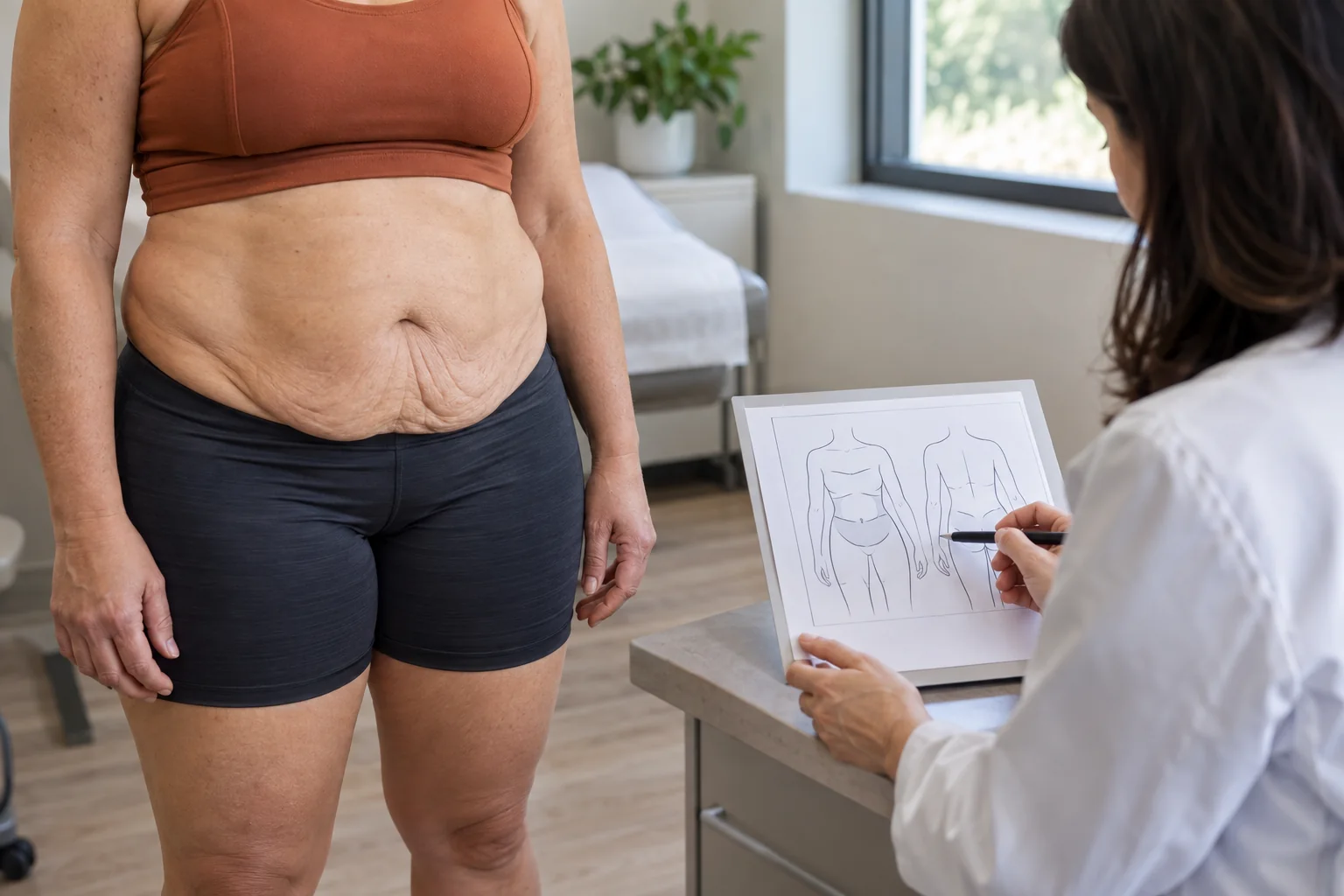
Where excess skin gathers
After a large weight loss, redundant skin can sit in more than one place. The abdomen is the area this site treats in depth: a fold above the pubic area, an apron that hangs, or looseness above and below the umbilicus. Arms, inner thighs, and the chest can also carry folds. Naming them matters so that an abdominal operation is not expected to change a different part of the body. This page will not describe arm or thigh surgery as if it had been briefed here.
How the weight was lost does not pick the operation. Diet, bariatric surgery, and prescribed medicines can all leave the same sort of skin. This page does not name those medicines or give doses. The after-weight-loss hub makes the same limit. Loose skin is not a failed weight loss. You can be glad the weight came down and still decide against surgery.
On the abdomen the fold has a few usual shapes, and they are not one operation. A small amount of loose skin that sits only below the umbilicus is a different request from an apron that hangs over the pubic area, and both are different from looseness above the umbilicus as well as below it. Arms, thighs, and the chest can carry their own folds at the same time. An abdominal operation does not tighten an arm. If more than one area is being discussed, ask which operation covers which area, and which areas are being left alone. Combining them is a longer plan, and it is not described on this page.
Skin removal surgery, as a phrase, is wider than a tummy tuck. Body contouring is the surgical name sometimes used for the same idea. On this site both phrases mean operations that take away excess skin. The depth is the abdomen. If a letter uses one of those phrases, ask which incision is planned and whether muscle repair is included. The words alone do not tell you.
The problems it causes
A fold is not only a shape in the mirror. Skin that rests on skin stays warm and damp. People describe a rash in the crease, sometimes called intertrigo when a clinician uses that word, and episodes of infection that need assessment rather than a homepage remedy. They describe itching, odour, broken skin, and difficulty getting the area fully dry after washing. Clothing can rub. Walking, exercise, and sexual intimacy can be limited by the weight of an apron or by soreness, not by a lack of willpower.
Funding policies and surgeons ask about function, not only appearance. A symptom that never enters the GP record is hard for anyone else to use. If the skin is infected now, contact the GP. This site will not score you, and it will not show patient photographs. Appearance-only distress is still a different question from a fold that breaks down. The local document decides what evidence is enough.
Abdominal options: apronectomy vs abdominoplasty
Two names get collapsed into “a tummy tuck” and should not be. An apronectomy, or panniculectomy, removes the hanging apron of skin and the fat in that apron. A full abdominoplasty removes excess skin and subcutaneous fat and, when indicated, tightens the underlying muscle1. In the traditional operation the same source says the umbilicus is transposed. If you need muscle tightening or a moved umbilicus, you are not describing an apronectomy alone.
A 2022 analysis of American hospital records compared 6,397 functional panniculectomies with 4,740 cosmetic abdominoplasties2 from 2015 to 2019. The functional group had more other illnesses, and adverse events were higher. That is a United States database. It is not an NHS complication rate and it is not a UK price. It does show that the labels are not interchangeable. Read what an apronectomy involves before you consent to a name you have not matched to the plan.
| Question | Apronectomy | Full abdominoplasty |
|---|---|---|
| Main tissue removed | The hanging apron of skin and fat | Excess skin and fat above and below the umbilicus |
| Muscle tightening | Not part of the definition | When the surgeon judges it indicated |
| Umbilicus | Not repositioned as part of an apronectomy | Transposed in the traditional operation |
| How research groups it | Closer to functional panniculectomy | Studied separately as cosmetic abdominoplasty |
Other patterns exist, including operations that combine areas. They are outside this page. If a surgeon names one, ask which of the rows above still apply.
When to consider surgery: weight stability and timing
Surgeons, and integrated care boards in England, usually want the weight steady before skin is removed, because a fold can still change. This page will not say how many months to wait or what weight to reach. How to read a board’s wording is on weight stability. Timing after bariatric surgery is whatever that policy prints. A later pregnancy can change the abdominal wall an operation has just treated. Say so in the consultation.
Non-surgical care of skin folds while you wait
While you wait, the aim is to keep the fold clean and dry, not to shrink it. Wash the skin that sits against skin, including after exercise, and dry it fully, including the base of the crease. A soft cloth or a cool hairdryer on a low setting is sometimes easier than a towel you cannot reach with. Wear clothing that does not hold moisture if you can. Change out of damp clothes rather than sitting in them.
If the skin is broken, itchy, or repeatedly infected, ask your GP rather than buying a strong steroid or an antibiotic off the shelf. This page does not name a cream or a dose. The GP record is also what a later referral needs: dates of rashes, what was prescribed, and whether the skin settled. A symptom that never enters the notes is hard for a funding panel to see. If you feel unwell, or redness is spreading, contact the GP or NHS 111, or call 999 in an emergency. That is care for illness, not a funding decision, and it is not a food plan. Nothing in this section is a diet, a calorie target, or a dose of a weight-loss medicine.
NHS route
The NHS may consider skin removal when a local policy’s functional criteria are met. It does not offer a cosmetic tummy tuck as a routine service, and this page does not copy a body-mass threshold. Whether you fit is a question for the policy and your GP. Start with how NHS funding decisions are framed. There is no promise there either.
Cost
Private fees are not printed on this page. A second price for “skin removal” would break the rule that this site has one fee discussion, on the cost guide. If you are asking what a private operation costs, use the cost guide’s skin-removal section. The quote you are given still needs to say what is included. A headline is not that list.
Paying privately is not the same decision as qualifying on the NHS. This page does not rank clinics.
Recovery and scars
Removing skin leaves a scar. An apronectomy scar follows the tissue that was removed. A traditional abdominoplasty uses a longer pattern and moves the umbilicus. This page will not promise a hidden scar. Ask where it will sit in underwear, and ask when a photograph would be too early to judge it. Swelling can last for months. A picture at three weeks is not the settled outline.
The first weeks are about the wound, walking, and lifting less than usual. Drains are sometimes used. A compression garment is ordinary advice and does not replace the operation. Read recovery for the general course. Sudden breathlessness, chest pain, a high temperature, a wound that opens, or redness that spreads should go to your GP, NHS 111, or 999 if you are acutely unwell. Those signs are the same whether the operation was discussed as skin removal or as a tummy tuck.
Complications are part of an honest description. A 2017 literature review reported that about 10% to 20% of patients have a local complication after abdominoplasty, and fewer than 1% have a systemic complication3. A later meta-analysis of 4,295 patients found overall complication rates in the included studies ranging from 9.3% to 33.8%4. For individual problems — seroma, haematoma, infection, necrosis, wound opening, revision, and venous thromboembolism — the authors found no significant difference between the drain and suture combinations they compared. That result does not mean drains prevent a seroma. It means this review did not show that one combination clearly lowered each named complication.
The functional panniculectomy group in the US database had more adverse events than the cosmetic abdominoplasty group.2 If your operation is the functional one, do not borrow a “cosmetic” risk sentence and assume it is yours. Individual risk is for the clinician who can examine you. Sudden breathlessness, chest pain, a high temperature, or a wound that opens should go to your GP, NHS 111, or 999, not to a later routine appointment.
Frequently asked questions
-
What is skin removal surgery after weight loss?
Skin removal surgery takes away skin and the fat directly under it in the area that is operated on. At the abdomen, that may be an apronectomy or a fuller abdominoplasty, and those are not the same operation. It does not replace the weight loss you have already done, and it is not a plan for losing more. This site does not set a weight to aim for and does not describe the surgery as fixing a personal failing.
-
Where does excess skin gather?
It can gather at the abdomen, the arms, the thighs, and the chest. This site explains the abdominal operations in detail and only names the other areas so you know they exist. A fold under the abdomen is the problem most often brought to a conversation about an apronectomy. Which area matters to you should be said plainly, because an abdominal operation does not treat the arms.
-
What problems can a skin fold cause?
People report soreness where skin rubs, rashes in the fold, repeated infection, difficulty washing and drying, limits on movement, and trouble with clothing. Those are functional problems, not a comment on appearance. How many of them, and how severe, is a matter for your GP record. This page does not score symptoms or say that a particular number of infections qualifies you for surgery.
-
Is an apronectomy the same as a tummy tuck?
No. An apronectomy removes the hanging apron. A full tummy tuck can also tighten muscle when a surgeon judges that indicated, and it moves the umbilicus. The surgical literature studies functional panniculectomy and cosmetic abdominoplasty as different groups. Read the abdominal options on this page, then the apronectomy page, before you use one name for both.
-
When is the timing right?
Teams and, in England, local NHS policies usually want weight to be stable first. This page does not define stable as a number of months or a number of kilograms. That definition is in the policy or in the surgeon's own criteria. The weight-stability page explains how to document what is already in your notes. It is not a diet.
-
Does the NHS pay for skin removal?
Sometimes, under a local policy, when a functional problem is documented. Cosmetic contour is a different request. There is no single national yes on this page, and there is no promise that you will be funded. Start with the NHS page, and use the cost guide only if you are asking about paying privately. This page does not print a fee.