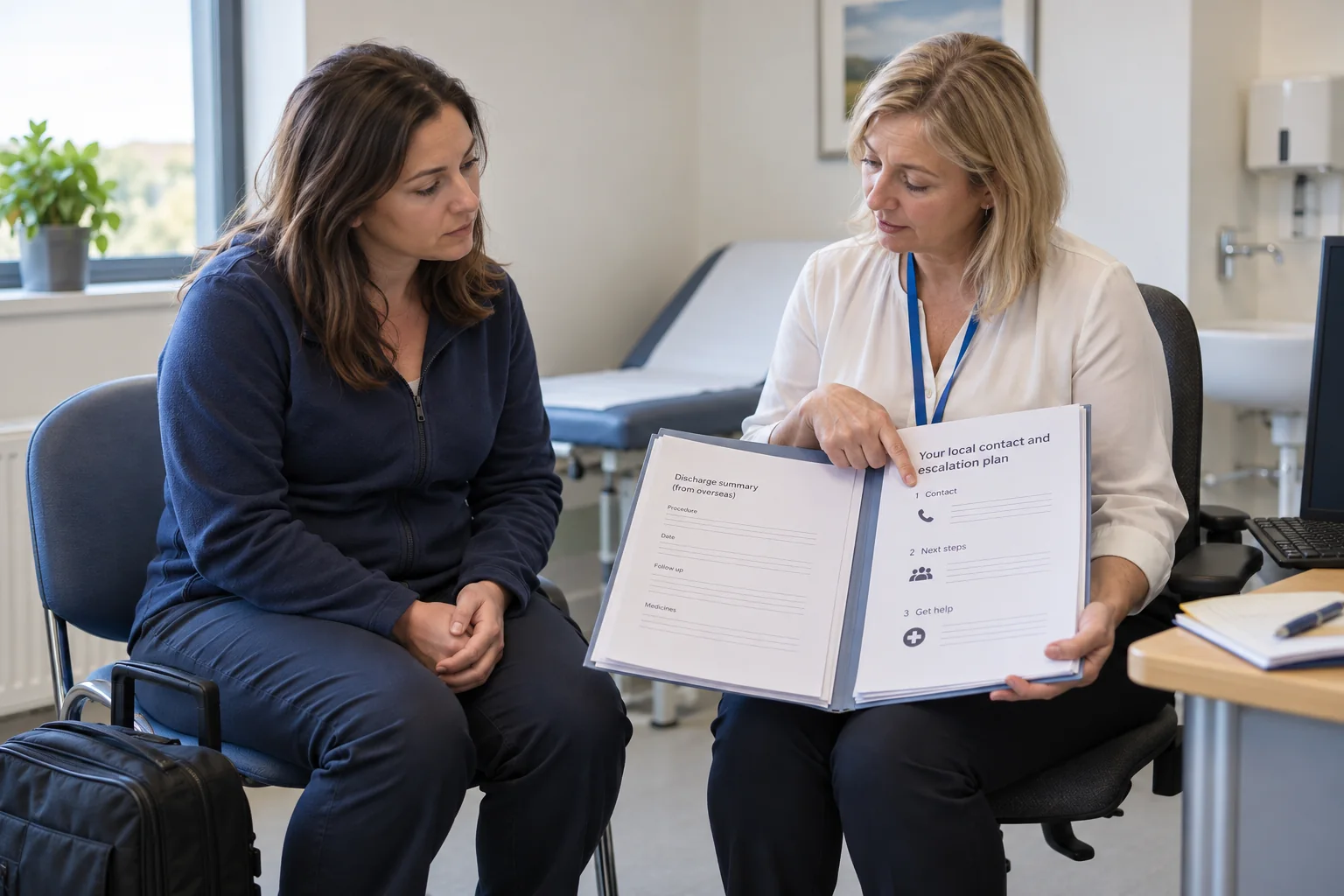
If you are unwell after an operation and you are back in the UK, do not wait for an overseas clinic to answer. Sudden breathlessness, chest pain, heavy bleeding, or collapse: call 999. A high temperature, a wound that is opening, spreading redness, or a calf that swells on one side: contact NHS 111 if you are not in immediate danger, and 999 if you are. Tell them you have had abdominal surgery, and when. This page cannot see your wound.
Tummy tuck abroad complications are what this site means by the follow-up gap. The comparison of headline prices is on the cost comparison. What to do when an operation has gone badly, including in the UK, is on when a tummy tuck goes wrong. The pages below stay with one problem: you had the operation in another country, and you are now at home.
The follow-up gap
A tummy tuck does not end when the dressing goes on. Someone removes sutures or checks dissolving ones. Someone looks at the wound. A collection of fluid under the skin, a seroma, is a known local problem and often needs a clinician to assess it, sometimes to drain it. None of that happens by message if the only surgeon who knows the operation is a flight away.
StatPearls describes one or two drains as typical after abdominoplasty, and not mandatory2. If you still have a drain when you fly, you need a written plan for who empties it, who removes it, and what volume should make you seek help. If you have no drain, you still need a plan, because "no drain" is not "no fluid".
A 2017 review put local complications at about 10% to 20% of patients, with systemic complications under 1%1. The review discusses seroma, haematoma, infection, skin necrosis, scar problems, problems at the umbilicus, and venous thromboembolism. Those are problems of the operation. They are not a rate for one country, and they are not a reason to skip the question of who is on call when you are in your own bathroom two weeks later.
A later meta-analysis found overall complication rates in the included studies ranging from 9.3% to 33.8%3. For the individual complications the authors compared, including seroma and venous thromboembolism, they did not find a clear winner among the drain and suture combinations in that review. The practical point is modest. Complications happen often enough that "it will be fine once I land" is not a plan, and the published range is too wide to treat as a single number you can shop with.
Will the NHS treat complications?
Keep two questions apart. The first is urgent illness: a clot, heavy bleeding, a serious infection, a wound that is falling apart. In the UK that is what NHS 111 and 999 are for. Having chosen surgery in another country does not switch those numbers off. Staff will still need to know what was done. That is why the operation note matters. This page does not describe hospital policy, and it is not a statement of what a particular emergency department must do.
NHS.uk says complications can happen after surgery in the UK or abroad. If the operation was in the UK, follow-up treatment is the surgeon’s responsibility4. An overseas clinic may not provide that follow-up, or not to the same standard, and it may not have a healthcare professional in the UK. The same page says travel insurance does not normally cover things going wrong in surgery, and that air travel and major surgery increase the risk of a blood clot. It recommends not flying for 7 to 10 days after a tummy tuck4. That is NHS advice, not a promise that a clot cannot occur later, and not a reason to ignore the surgeon’s own instruction if it is stricter.
The second question is cosmetic revision: a contour you dislike, a scar you dislike, a result that is not what you paid for, once you are medically well. That is not the same request as emergency care. NHS.uk does not say the NHS will revise a cosmetic result done abroad. Funding and acceptance vary, including between integrated care boards. Read the NHS page for how funding decisions are approached in general. Do not read it as a promise that a revision will be done on the NHS because the first operation was abroad.
Nothing in this section is legal advice. It does not tell you whether you have a claim, against whom, or in which country. If you need that, you need a lawyer, not a surgical guide.
Can a UK private clinic take over?
A private surgeon in the UK may agree to see a complication, or to plan a revision later, and they may refuse. Refusal is common enough that you should not book travel on the assumption that "someone at home will sort it". Ask a named surgeon, before you fly, whether they are willing to see you if there is a wound problem, and what they will not take on. Get the answer in writing if you can.
This site does not rank or recommend individual clinics or surgeons. A clinic that advertises revision of surgery done abroad is still a private service with its own fees and its own limits. Those fees are not printed here. The fee guide explains how this site handles a surgeon fee. It is not a quote for someone else's revision.
Travel insurance and elective surgery
A holiday policy is a poor thing to discover in a side room. Planned cosmetic surgery is often outside what a travel policy was written to cover, and complications of that surgery may be outside it as well. "Often" is not a percentage. This page does not cite an insurer's wording, so it will not pretend that every policy excludes the same list.
What you can do is specific. Ask the insurer, in writing, whether elective abdominal surgery abroad is covered, whether complications after you return are covered, and whether a medical flight is covered. Save the reply. If the reply is no, the price of the operation was never only the headline. If you cannot get a reply, you do not yet know the answer, which is different from hoping the answer is yes.
Before you travel: a checklist
Do this before a deposit, not in the departure lounge. The questions to ask before you book go further into the surgeon and the anaesthetic. This list is only the part that matters once you are home.
- Tell your GP you are planning abdominal surgery abroad, and when.
- Ask the operating team for the operation note, in a language you can give to a UK clinician. Ask for the name of the person who will actually operate.
- Get a written follow-up plan: who removes sutures, who assesses swelling or fluid, and which symptoms should not wait.
- Ask your insurer, in writing, what is excluded. Keep the email.
- Know the UK numbers before you fly: NHS 111, and 999 in an emergency.
If any line comes back blank, you are being asked to travel without a plan for tummy tuck abroad complications. That is a reason to pause. It is not a detail the hotel can fix.
Warning signs after you land
Some discomfort, swelling, and a bent posture are common after a tummy tuck. The signs below are not "give it a day". Venous thromboembolism and infection are among the problems discussed in the abdominoplasty complication review already cited. This list is not a diagnosis. It is a reason to use the NHS, not a messaging app.
- Sudden breathlessness, chest pain, coughing blood, or collapse: call 999.
- A calf or thigh that swells and hurts on one side: NHS 111, or 999 if you are breathless or faint.
- A high temperature, shaking, or redness that is spreading: NHS 111, or 999 if you are very unwell.
- A wound that opens, bleeding that soaks dressings, or fluid that is suddenly much heavier: NHS 111, and 999 if the bleeding will not stop.
- Severe pain that is new, or an abdomen that is much harder than it was: do not wait overnight on the assumption that tightness from the repair explains it.
Contact your GP as well when the problem is slower: a wound that is not settling, a swelling you think may be fluid, or a worry that can wait for a same-day or next-day clinical view. GP, NHS 111, and 999 are three different speeds. Using the wrong one in either direction is the mistake. If you are unsure and you feel seriously ill, 999 is the call.
Frequently asked questions
-
Who looks after a wound once I am back in the UK?
The operating surgeon may already be in another country. Sutures, a seroma, and ordinary wound checks need a named person at home, agreed before you travel. Your GP can be told in advance, but that is not the same as a surgeon agreeing to take over the operation. The questions page is where that agreement is spelled out as something you ask for in writing.
-
Will the NHS treat a complication after surgery abroad?
Urgent illness is an NHS emergency question. NHS 111 and 999 exist for that, including after an operation done in another country. A request to revise the cosmetic result is a different request, and it is not guaranteed. Local policy varies. This page is not a ruling on what an integrated care board must fund.
-
Can a private surgeon in the UK take over?
Sometimes a private surgeon will agree to see you, and sometimes they will not. There is no duty described on this page that forces a clinic to accept another surgeon's operation. Ask before you travel, and ask what they will and will not do. Nothing here recommends a named clinic.
-
Does insurance pay if something goes wrong?
Do not assume a travel policy covers planned cosmetic surgery or the problems that follow it. Ask the insurer, in writing, whether elective surgery abroad is excluded. This page does not quote a policy and it is not insurance advice. Get the answer before you pay a deposit, not after a wound has opened.
-
What should I bring home from the hospital?
Ask for the operation note, the name of the surgeon who actually operated, a list of medicines, and a written follow-up plan. You will need those if a GP or another surgeon sees you later. A photograph of a discharge summary on your phone is better than nothing. It is not a substitute for the note itself.
-
When should I call 999 after I land?
Call 999 if you are acutely unwell: sudden breathlessness, chest pain, heavy bleeding, or you are collapsing. Contact NHS 111 for a high temperature, a wound that is opening, or a calf that swells on one side if you are not in immediate danger. Do not wait for a clinic overseas to reply first. The safety page sets those problems in a wider context.