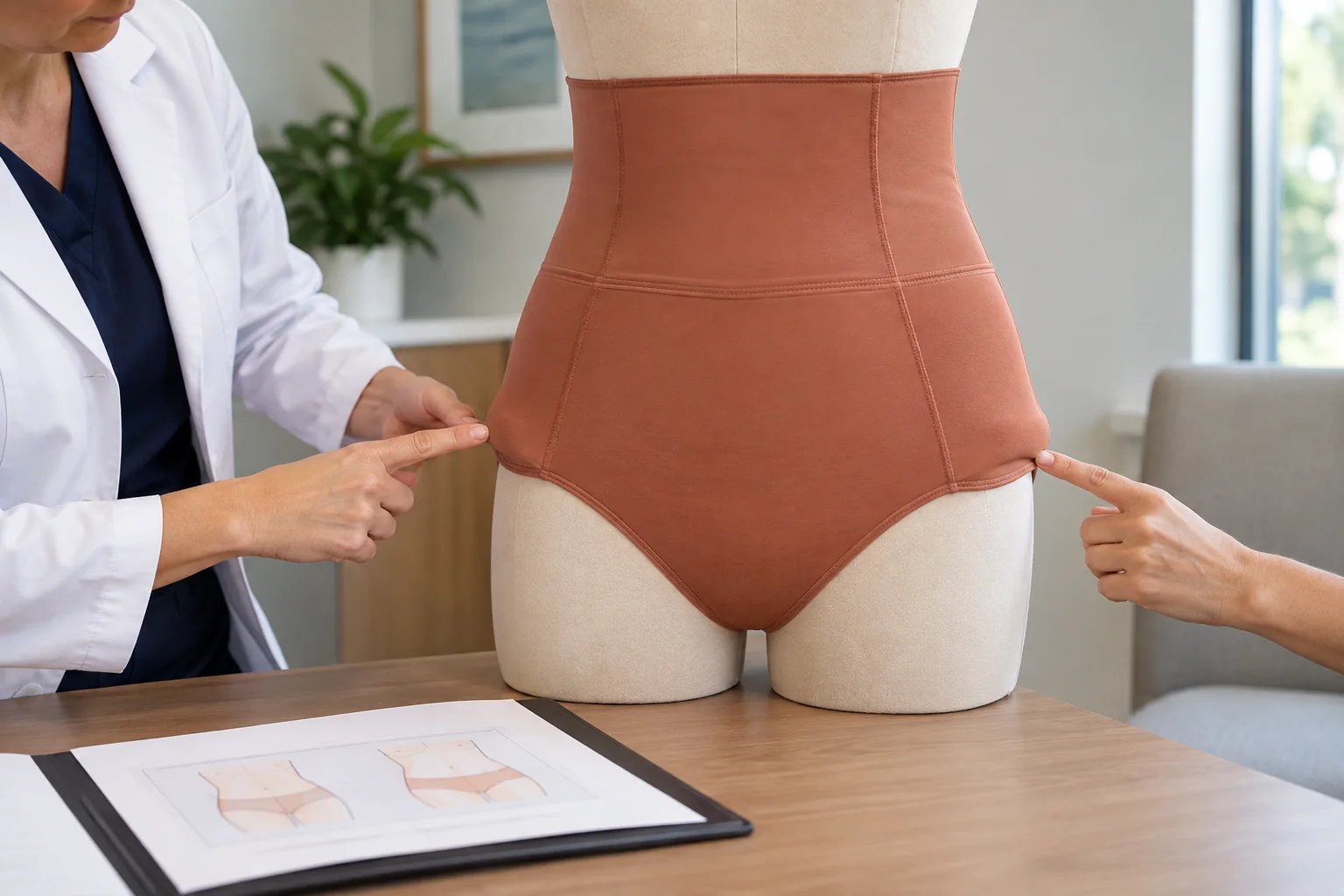
The phrase is unfortunate. “Dog ears” sounds like a mistake you should be angry about, and sometimes the pucker is genuinely disappointing. The anatomy is simpler than the nickname. A tummy tuck closes a long wound. Where that wound stops, the skin has to go from “removed” to “not removed”. If the transition is bunched, you see a cone. Understanding that saves you from treating every early lump as a disaster, and from being told that every lump will magically flatten.
What dog ears are
A dog ear is a standing fold or cone of skin and fat at the end of a scar. On a tummy tuck it is usually at one or both outer ends, near the hip crease. It can be a small peak you only feel, or a fold that shows under fitted clothes. It is an appearance issue. It is not a clot, an infection, or a wound that has come apart, unless the skin over it is actually open or red in the ways described below.
The main scar of a traditional operation is a horizontal incision1. Horizontal scars have ends. The ends are where dog ears live. The long scar itself, and how it matures, is the subject of the scars page. A dog ear can sit on a scar that is otherwise healing in an ordinary way.
Why they happen
Think of shortening a piece of fabric. If you take a large tuck out of the middle and sew it, the corners poke up unless you extend the seam or tailor the ends. The abdomen is not fabric, but the geometry is the same. More skin removed centrally than laterally, a closure that pleats the corner, or a hip that is still full beside a tight centre, all push tissue to the end of the line.
A review of complications discusses problems that change the aesthetic result, including hypertrophic scars2, and it reports local complications in about 10% to 20% of patients2. It does not publish a dog-ear rate. This page will not borrow the local-complication range and pretend it is the chance of a pucker. The range covers a mixed group of wound problems. A dog ear is more specific than that, and less well counted in the sources this site is willing to use.
| What you see | Possible reading | Sensible next step |
|---|---|---|
| A soft peak in the first weeks, with general swelling | Swelling may be exaggerating the end of the scar | Wait for review. Do not book a revision yet. |
| A fold that is still obvious once swelling has settled | Extra skin at the corner may remain | Ask about revision versus leaving it. |
| The end of the scar splits, bleeds, or becomes hot and red | A wound problem, not only a pucker | GP, NHS 111, or 999 if you are severely unwell. |
Do they settle on their own?
Some do, in the limited sense that swelling was most of what you saw. As the abdomen deflates and the scar softens, a mild peak can lie flatter. Give that process months, not days. The scar’s own maturation is slow, often talked about over 12 to 18 months on the scars page. A dog ear made of extra skin does not mature away. Skin you can pinch as a fold, once the rest of the swelling has gone, is skin. Waiting will not delete it.
There is a cost to waiting and a cost to operating too soon. Too soon, and the revision chases a shape that was going to change anyway. Too late is rarely a medical emergency. It is frustrating. A reasonable path is to let the early swelling declare itself, then look again with the surgeon and decide. If the pucker is tender because a waistband rubs it, a clothing change is a fair bridge. It is not a treatment.
Revision options and timing
The usual revision is small. The bunched skin is removed and the scar is extended a short distance so the end can lie flat. You trade a pucker for a slightly longer line. Sometimes both sides are done so the scar stays even. It can be under local anaesthetic. This page does not promise that, because the anaesthetic is the surgeon’s decision, and it does not describe doses or how the cut is made.
Timing follows the same logic as other scar revisions. Swelling should have settled enough that the fold you are removing is the fold that will remain. That is later than the first month for most people, and it is not a date this page will invent. Ask three practical questions: how much longer will the scar be, will both sides be needed, and what does “leave it” look like in clothes you actually wear? A small dog ear that does not show in your life is allowed to stay. Wanting it gone is also reasonable. Neither answer is a favour you owe the original operation.
The recovery overview is the place this problem sits among swelling, scars, and the early weeks. A dog ear is not, on its own, one of the urgent patterns on the safety pages. An infected or open corner is.
When to get help
When to get help for the pucker itself is follow-up, not an ambulance. When to get help for the skin is the same rule as any other part of the wound:
- the corner splits open or will not stop bleeding
- redness spreads, or you develop a high temperature
- there is pus or a foul smell
- you have chest pain or sudden breathlessness, which is unrelated to the shape of the scar and still urgent
Contact your GP or NHS 111, or call 999 in an emergency. NHS 111 can direct you if you are unsure and you are not in immediate danger. Do not lance, tape shut, or inject a dog ear. The page on disappointing and serious outcomes keeps appearance problems and emergencies apart, which is the distinction a dog ear needs.
Frequently Asked Questions
-
What are dog ears after a tummy tuck?
Dog ears after a tummy tuck are cones or puckers of skin at the outer end of the scar, usually toward the hip. The name is descriptive. It is not a diagnosis of a failed operation, and it is not a complication rate. The skin at the end of a long closure has not lain flat, so it stands up. Clothes can catch on it. Some people barely notice a small pucker. Others find it the most annoying part of an otherwise acceptable result. Swelling can make a pucker look larger than it will later.
-
Why do dog ears happen?
A long horizontal scar has to start and stop somewhere. If more skin is removed in the middle than at the ends, or if the closure gathers the corner, the end bunches. Body shape matters: a wide hip, or skin that is still full at the side, gives the scar less room to finish flat. This page does not cite a percentage of people who get dog ears, because the confirmed sources do not report one. The pucker is a geometry problem at the end of the incision, which is why it sits at the end and not in the middle.
-
Will dog ears go away on their own?
Some soften as swelling goes down and the scar relaxes. A pucker that is mostly fluid and tightness can look much smaller after a few months. A true excess of skin at the corner often does not vanish, because maturation changes colour and firmness more than it removes tissue. Wait long enough to know which of those you have. Do not decide in the first fortnight, when the whole abdomen is swollen. Do not assume that waiting a year will erase a fold of skin that was never going to flatten.
-
Can dog ears be revised?
Often yes, and the revision is usually smaller than the original operation. A short extension of the scar, or removal of the bunched skin, can flatten the corner. The scar becomes a little longer. That trade is the decision. Timing is after swelling has settled and you can see the real contour, not in the first weeks. This page does not name a compulsory month, and it does not quote a success rate. Ask what the extra scar length will be, and what happens if you leave the pucker alone.
-
Are dog ears a sign the surgeon did something wrong?
Not by themselves. They are a known contour issue at the end of this kind of scar. They can follow a carefully planned operation, and they can also follow a closure that did not take enough skin at the side. Looking at the pucker does not tell you which. This site does not rank surgeons, and a dog ear is not evidence you can use to do that from a photograph. If you are unhappy, ask for an examination and a plain account of the options. Blame is not a treatment.
-
When should I get help for a dog ear?
A stable pucker is not an emergency. Ask about it at follow-up. Contact your GP or NHS 111 the same day if the skin over it splits, bleeds, becomes rapidly red, or you have a high temperature. Call 999 if you are severely unwell or bleeding heavily. Those are wound problems that happen to sit at the end of a scar. The pucker itself can wait. An opening wound should not. This page cannot look at the corner for you.