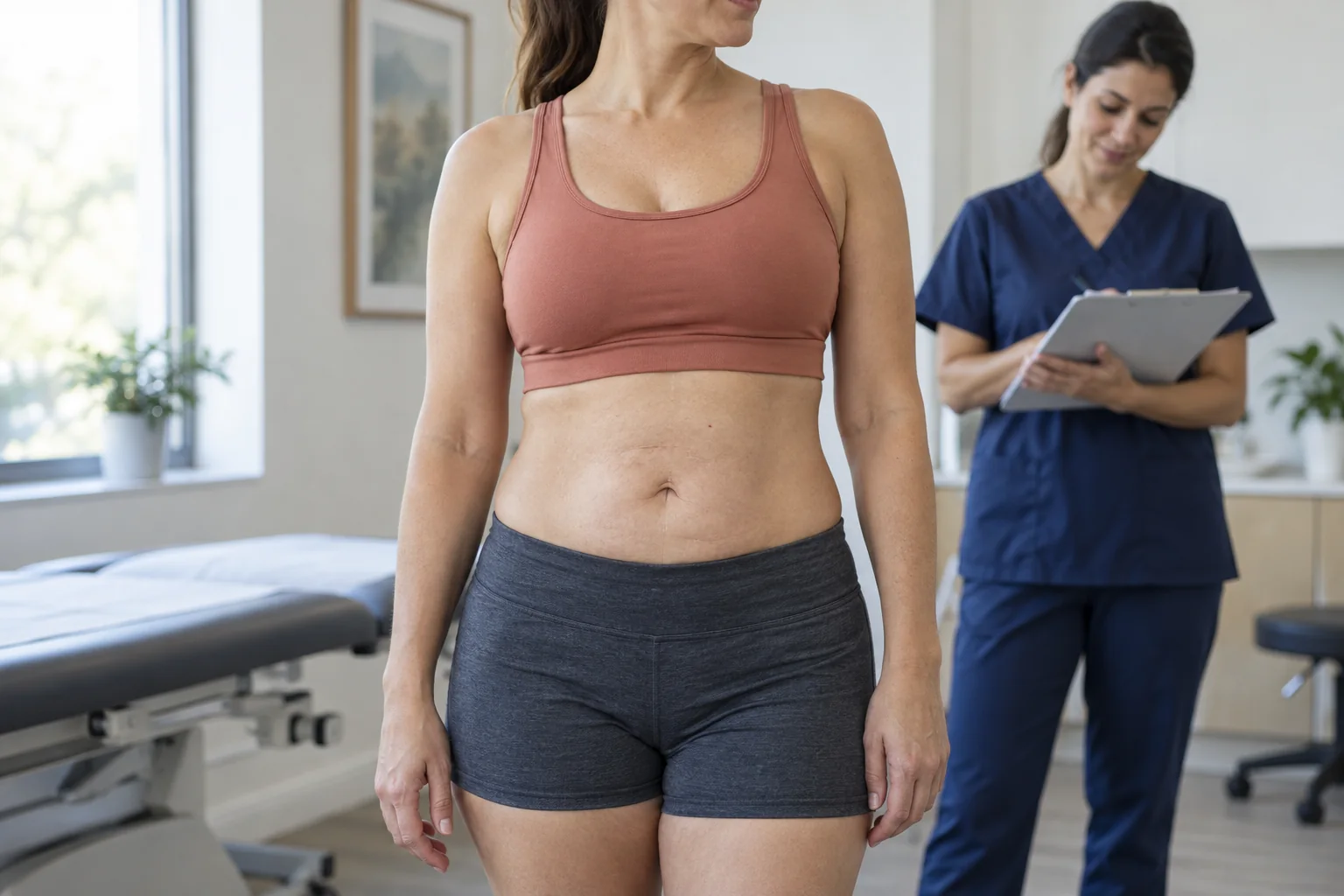
The question under most results pages is a personal one: will I look like that? No article can answer it for a named person. What an article can do is separate three things that get bundled together. The first is what the operation is built to change. The second is what it leaves behind. The third is what a pair of photographs can fairly be asked to prove.
This site is not a clinic. It does not rank surgeons by their photographs, and it does not invite you to judge a result from a single flattering angle. The two pages below are the whole of this section.
How to read before and after photos
A before-and-after pair is, at best, one patient at two moments. The moments are only comparable if the distance, the light, the posture, and the clothing are the same. Weight change between the pictures, a compression garment, and editing can all move the outline without the operation having done that work. An early “after” picture is also a picture of swelling.
How to check those points, including eight questions worth asking of any gallery you are shown, is on how to read before and after photos. That page does not display patient photographs.
What changes and what doesn’t
The operation removes excess skin and fat in the area that is cut away, and it can tighten muscle when that is part of the plan. It does not remove a fixed number of dress sizes. Stretch marks on skin that is taken away go with that skin. Stretch marks elsewhere stay. Cellulite is not the target. A large change in weight later, or a pregnancy, can alter what you see.
The limits, and the honest answer to the size question, are on what a tummy tuck changes.
Why we don’t publish a photo gallery
A gallery would answer the wrong question. The pictures that get published are chosen. They are not a random sample of everyone who had the operation, and they are not a sample of the people who were unhappy. Choosing the clearest transformations and leaving out the ordinary ones is selection bias. A reader cannot see the cases that were never posted.
Even a genuine pair of photographs is hard to compare. If the after picture is closer to the camera, taken with a harder light, or taken while the person is breathing out and bracing the abdomen, the waist looks smaller for reasons that are not the scar. Filters, smoothed skin, and a background that bends are further reasons not to treat a picture as a measurement. Patient photographs are also medical information. Publishing them here would not help you predict your own healing, and it would trade someone else’s privacy for a more persuasive page.
UK advertising rules expect cosmetic claims, including images, not to mislead. This site does not enforce those rules, and it is not endorsed by the regulator that does. The practical consequence on these pages is simple: we teach you how to read a photograph, and we do not pretend that a gallery is evidence about what will happen to you.
If you are shown photographs elsewhere, use the questions on the reading page before you treat them as a forecast. If you want the boundary of the operation itself, use the page on what changes. Neither page is a substitute for a consultation, and neither is an offer of surgery.